Back
Work AI
Difference Between Structured and Unstructured Data

Tushar Dublish

Data is everywhere. It’s in your emails, your bank statements, your WhatsApp chats, your Instagram photos, your company’s CRM, and even in the sensor that tells your smartwatch how many steps you walked today. Yet, not all data is created equal. Some data behaves neatly, almost obediently, while other data is messy, wild, and refuses to sit still.
That’s where the difference between structured and unstructured data comes in.
If you’ve ever wondered why Excel loves some data but struggles with others, or why AI tools obsess over “unstructured data,” you’re not alone. This topic sits at the heart of analytics, AI, databases, SEO, machine learning, and modern business intelligence.
In this article, we’ll break down structured vs unstructured data in plain English. No jargon overload. No robotic explanations. Just clear thinking, real examples, and practical insights. We’ll also explore how structured data and unstructured data differ round by round, where each shines, and why both matter more than ever.
So, buckle up. Let’s untangle this data puzzle, one layer at a time.
What is Data, Really?
Before splitting hairs, let’s zoom out and look at the bigger picture for a moment.
At its core, data is simply information captured in some form. It could be numbers, words, images, sounds, signals, or even machine‑generated logs quietly running in the background. Data tells stories. Be it about customers, systems, markets, or human behavior, etc. And sometimes, those stories are obvious. Other times, they’re buried deep, waiting to be uncovered.
What truly separates useful data from noise isn’t just its existence, but how it is collected, stored, and interpreted over time. The same piece of information can feel incredibly powerful or completely useless depending on how it’s handled.
But how data is organized (or not) changes everything. Organization determines whether data can be searched quickly, analyzed at scale, or trusted for decision‑making.
That’s the key idea behind the difference between structured and unstructured data. And it’s why this distinction matters far more than most people initially realize.
What is Structured Data? Explained Simply.
Structured data is the “well‑behaved student” of the data world. It follows rules, raises its hand, and rarely surprises anyone.
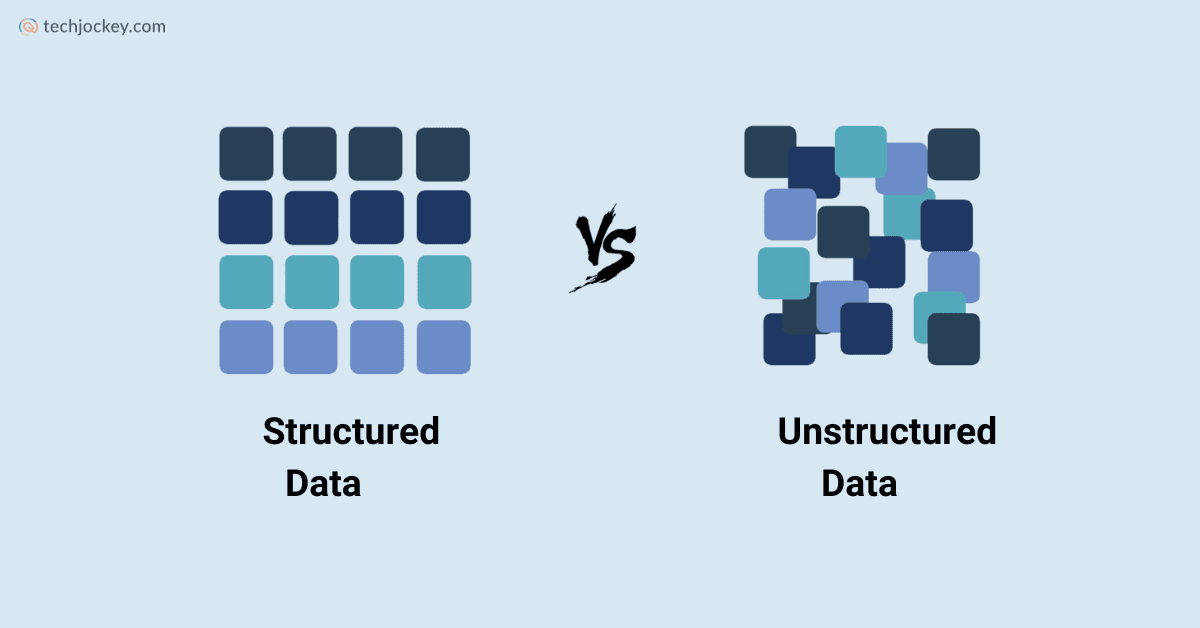
It follows a predefined format, fits neatly into rows and columns, and plays nicely with traditional databases that expect order and consistency. Each value knows exactly where it belongs, and each field has a clear purpose. Think tables, schemas, and fixed fields that leave very little room for ambiguity. Because of this predictable structure, structured data is easy to validate, easy to query, and easy to trust when accuracy and speed matter most.
Key Characteristics of Structured Data
These characteristics explain why structured data is so reliable, predictable, and widely used in traditional analytics systems.
Organized in rows and columns, making the data visually clean and logically ordered
Follows a strict schema that clearly defines what each field represents
Stored in relational databases designed for accuracy and transactional reliability
Easy to search, sort, filter, and analyze using standard query languages like SQL
Highly consistent across records, which reduces errors and improves trust in reports
Taken together, these characteristics explain why structured data has been the foundation of business systems for decades. It thrives in environments where accuracy, repeatability, and speed are non‑negotiable, such as finance, operations, and reporting.
While it may lack flexibility, its strength lies in reliability. When organizations need dependable numbers they can act on with confidence, structured data consistently delivers.
Common Examples of Structured Data
Customer names, emails, and phone numbers in a CRM
Transaction records in a banking system
Product prices and SKUs in an e‑commerce database
Employee records in HR software
Survey responses with fixed options
In short, if data can be easily put into a spreadsheet, it’s probably structured and designed to be handled by traditional databases and analytics tools.
In enterprise environments, structured data often lives in systems like CRMs, ERPs, analytics tools, and ticketing platforms. Tools like Action Sync use this structured data as a reliable foundation, pulling accurate metrics, records, and system facts that AI can trust when answering questions or automating workflows.

What is Unstructured Data? Explained Simply.
Unstructured data is the free spirit. The rebel. The creative chaos that refuses to be boxed in or neatly labeled.
It does not follow a predefined structure. There are no fixed rows, no guaranteed columns, and no universal format to keep things predictable. Instead, it flows naturally, shaped by human expression, real-world interactions, and constantly changing contexts, which makes it both incredibly powerful and notoriously difficult to manage.
Key Characteristics of Unstructured Data
Unstructured data may look chaotic at first glance, but it follows a few recognizable patterns. These characteristics help explain why unstructured data is harder to manage, yet incredibly valuable for capturing real-world context and human intent.
No rigid schema, meaning the data does not follow a predefined structure or fixed layout
Comes in many formats such as text, images, audio, video, and documents
Difficult to analyze with traditional tools that rely on tables, rows, and columns
Rich in context and meaning, often capturing emotions, intent, and nuance
Often human‑generated through conversations, interactions, and creative expression
Together, these characteristics highlight why unstructured data plays such a critical role in modern decision‑making. While it may lack the neat order of structured data, it more than makes up for it in depth, nuance, and real‑world relevance.
Unstructured data captures how people think, feel, and behave. Thus, making it invaluable for understanding intent, sentiment, and context.
This is where traditional analytics tools struggle, but modern enterprise search AI thrives. Action Sync AI, for example, can understand unstructured data like internal documents, emails, knowledge bases, and conversations, allowing teams to ask natural questions and get context-aware answers without manually searching through files or chat histories.
When organizations learn how to process and analyze it effectively, this seemingly chaotic data becomes a powerful source of insight.
Common Examples of Unstructured Data
Emails and chat messages
Social media posts and comments
Images, videos, and audio files
PDFs, Word documents, and presentations
Customer reviews and feedback
Here’s the kicker: over 80% of the world’s data is unstructured. Yes, you read that right, and it often surprises people when they first hear it. Most data doesn’t sit quietly in tables or spreadsheets; instead, it lives in emails, messages, images, videos, documents, and countless other forms created every single day.
Why the Difference Between Structured and Unstructured Data Matters
You might ask, “Okay, but why should I care?” And honestly, it’s a fair question. Especially if data feels like something only analysts or engineers need to worry about.
Because the difference between structured and unstructured data affects far more than just databases or dashboards. It quietly influences how organizations operate, how technology evolves, and how confident leaders feel when making critical decisions.
This difference shapes:
How businesses make decisions, from daily operations to long‑term strategy
How AI models learn, adapt, and improve over time
How insights are extracted, interpreted, and turned into action
How scalable your systems are as data volumes grow rapidly
How competitive your organization becomes in a data‑driven market
Ignoring this difference is like using a hammer for every job. You might get some results, but you’ll also cause unnecessary damage. Sometimes, you need a scalpel for precision. Sometimes, a bulldozer for scale. Knowing the difference helps you choose the right tool every single time.
Structured vs Unstructured Data: A Round‑Wise Comparison
Let’s get practical. Below is a round‑wise comparison covering major aspects where these two types differ.
Round 1: Data Format
Structured Data:
It follows a fixed and predictable layout that makes it easy for systems to store, process, and analyze information efficiently. Because the structure is predefined, every piece of data has a specific place and purpose, leaving little room for confusion or inconsistency. This level of organization is what allows structured data to work so well with traditional databases and analytics tools.
Fixed format that remains consistent across all records
Organized into tables with clearly defined rows and columns
Uses clearly defined data types such as integers, text, dates, or decimals
Unstructured Data:
It does not conform to any single format or layout, which makes it far less predictable than structured data. It can appear in many different forms, grow rapidly in size, and change shape depending on how and where it is created.
This lack of uniformity is exactly what makes unstructured data challenging to organize, yet extremely powerful when it comes to capturing real-world information.
No fixed format that enforces consistency across records
Includes text, images, audio, video, and other rich media formats
Varies widely in size, length, and internal structure from one data source to another
Winner: Structured data wins for consistency. Unstructured data wins for flexibility.
Round 2: Storage Systems
Structured Data:
This is typically stored in relational database systems that are designed to handle highly organized information with precision and consistency. These databases rely on structured query language (SQL) to define schemas, enforce relationships, and ensure data integrity, making them ideal for transactional systems and reliable reporting.
Stored in relational databases that use SQL for structured querying and management
Designed to enforce schemas, relationships, and data integrity rules
Common examples include MySQL, PostgreSQL, and Oracle, which are widely used in enterprise search environments
Unstructured Data:
This is usually stored in modern storage systems built for scale and flexibility rather than rigid organization. Instead of relying on traditional databases, it is kept in data lakes or object storage platforms that can handle massive volumes of raw data in its original form. These systems are designed to store everything first and process it later, making them ideal for handling diverse and continuously growing unstructured data.
Stored in data lakes or object storage systems optimized for large-scale, flexible storage
Designed to hold raw data without enforcing strict schemas at ingestion time
Common examples include Hadoop, AWS S3, and Google Cloud Storage, which are widely used for big data and analytics workloads.
Winner: Depends on scale and use case. Structured systems are efficient; unstructured systems are scalable.
Round 3: Ease of Analysis
Structured Data:
It is designed to be analyzed quickly and efficiently, which is one of its biggest strengths. Because the data follows a predefined structure, analysts and systems can retrieve exactly what they need without extra processing or guesswork. Queries run faster, insights surface sooner, and decision‑making becomes far more straightforward.
Easy to query because data is neatly organized and indexed
SQL works like magic by allowing precise, readable queries to fetch specific information
Enables fast analytics, making it ideal for dashboards, reports, and real‑time insights
Unstructured Data:
This is considered far more complex to analyze because it lacks a predefined structure. Before any meaningful insight can be extracted, this data usually needs to be cleaned, organized, and transformed into a usable form. Unlike structured data, analysis does not happen instantly and often relies on advanced technologies to interpret context, patterns, and meaning.
Requires preprocessing to clean, normalize, and prepare raw data for analysis
Needs technologies like NLP, computer vision, or machine learning to interpret text, images, audio, or video
Involves time‑consuming analysis due to the additional steps required before insights can be generated
This gap is why enterprise AI layers are becoming essential. Instead of forcing unstructured data into rigid tables, tools like Action Sync analyze it directly using AI, making emails, documents, and conversations searchable and actionable alongside structured dashboards.
Winner: Structured data, hands down, for speed and simplicity.

Round 4: Flexibility
Structured Data:
Here, we get reliability and consistency, but that stability comes at the cost of flexibility. Because the structure is predefined and tightly enforced, making changes later can be slow and complex. As systems grow and business needs evolve, even minor modifications to the data structure may require careful planning, migrations, and downtime.
Low flexibility due to strict schemas that must be defined in advance
Schema changes are painful, often requiring database redesigns, migrations, and updates across dependent systems
Unstructured Data:
It is built for adaptability and change. Because it does not rely on predefined rules or rigid schemas, it can easily accommodate new information, evolving formats, and unexpected data sources. This flexibility makes unstructured data especially valuable in fast‑moving environments where requirements change frequently, and data arrives in many different forms.
Extremely flexible, allowing data to be added, modified, or expanded without redesigning the entire system
No schema restrictions, which means new data types can be stored without prior planning
Easily adapts to changing business needs, user behavior, and emerging data sources
Winner: Unstructured data, without question.
Round 5: Business Insights
Structured Data:
It excels when the goal is to measure performance, track progress, and monitor outcomes over time. Because it is clean, consistent, and easy to aggregate, it works exceptionally well for quantitative analysis and standardized reporting. Businesses rely on structured data to understand trends, compare results, and make data-backed decisions with confidence.
Great for metrics and KPIs that need accuracy, consistency, and repeatability
Helps track performance over time through dashboards, reports, and scorecards
Clearly answers the question “what happened?” by showing measurable outcomes and results
Unstructured Data:
This stands out when the goal is to understand context, intent, and human behavior behind the numbers. Instead of focusing only on measurable outcomes, it helps organizations interpret experiences, emotions, and underlying reasons that drive results. This makes unstructured data especially powerful for strategy, customer understanding, and long-term decision-making.
Provides rich qualitative insights that go beyond surface-level metrics
Helps uncover patterns, sentiment, and intent hidden in text, images, audio, or video
Clearly answers the question “why did it happen?” by revealing context and human perspective
Winner: Unstructured data brings deeper context.
Round 6: Scalability
Structured Data:
Typically, it scales by increasing the capacity of existing systems rather than distributing the load across many smaller ones. This approach, known as vertical scaling, works well up to a point but becomes increasingly complex and costly as data volumes grow. As organizations demand more performance, storage, and reliability, scaling structured data systems can require significant investment in hardware, licensing, and maintenance.
Scales vertically by adding more power, memory, or storage to existing servers
Often requires specialized hardware or enterprise-grade infrastructure as scale increases
Can get expensive over time due to higher infrastructure, licensing, and maintenance costs
Unstructured Data:
It is designed to grow effortlessly alongside modern digital systems. Instead of relying on a single powerful machine, it spreads data and processing across multiple nodes, allowing systems to handle massive volumes without major disruptions. This approach aligns naturally with cloud environments, where scalability and flexibility are essential for managing ever‑increasing data streams.
Scales horizontally by distributing data across multiple servers or nodes
Handles growing data volumes smoothly without needing major system redesigns
Cloud‑friendly by design, making it well‑suited for modern, distributed architectures
Winner: Unstructured data systems scale better in modern architectures.
Round 7: Cost
Structured Data:
Systems using this often involve higher upfront investment and ongoing operational costs. Because these systems rely on well-defined schemas, specialized infrastructure, and strict performance requirements, organizations must invest in both technology and expertise to keep them running smoothly. Over time, maintaining accuracy, reliability, and performance can add to the overall cost.
Higher setup and maintenance costs due to enterprise-grade infrastructure and licensing
Requires skilled database management to design schemas, optimize queries, and ensure data integrity
Ongoing operational effort needed for monitoring, backups, upgrades, and performance tuning
Unstructured Data:
Such systems generally shifts costs away from storage and toward processing. Because modern storage systems are optimized for scale, storing large volumes of raw, unstructured data is relatively inexpensive. However, extracting meaningful insights from this data often requires significant computational resources, advanced tools, and specialized expertise, which increases processing costs over time.
Cheaper storage due to scalable, low-cost data lakes and object storage platforms
Higher processing costs driven by the need for AI, machine learning, and complex analytics
Additional expenses for compute power, tooling, and expertise to transform raw data into usable insights
Winner? It’s a tie. Storage vs processing costs balance out.

How AI and Machine Learning Changed the Game
Once upon a time, unstructured data was ignored. It was seen as messy, unpredictable, and simply “too hard” to work with using traditional tools and systems.
Not anymore.
Advances in AI, natural language processing (NLP), and computer vision have completely changed the landscape. These technologies can now read, see, listen, and interpret unstructured data at scale, turning what was once unusable information into actionable intelligence.
AI, NLP, and computer vision have unlocked massive value from unstructured data in areas such as:
Sentiment analysis from text, helping organizations understand opinions, emotions, and customer intent
Image recognition from photos, enabling systems to identify objects, faces, and visual patterns
Speech‑to‑text from audio, converting conversations and recordings into searchable data
Behavior analysis from video, revealing movement patterns, engagement, and real‑world interactions
Today, unstructured data fuels AI by providing rich, real‑world context, while structured data validates it by grounding insights in accuracy, metrics, and measurable outcomes.
Choosing Between Structured and Unstructured Data
Ask yourself a few honest questions before choosing an approach. The right answer often depends on what you are trying to achieve, how quickly you need results, and how much context your decisions require.
Do I need speed or depth, meaning fast, clear metrics or richer insights that take more time to uncover?
Do I want numbers or narratives, such as clean performance figures or detailed stories that explain user behavior and intent?
Do I need strict reporting for audits, compliance, and dashboards, or exploratory insights that help me discover new patterns and opportunities?
In reality, most modern systems don’t choose one over the other. They blend both structured and unstructured data, using each where it fits best, to create a more complete and balanced view of information.
Best Practices for Managing Both Types
Understanding the difference between structured and unstructured data is only half the battle. The real value comes from knowing how to manage, combine, and use both effectively in real-world systems.
These best practices help organizations get the most out of both data types without unnecessary complexity.
Use structured data for reporting and dashboards
Store unstructured data in scalable data lakes
Apply AI tools to extract meaning from unstructured data
Integrate insights back into structured systems
Define clear data governance policies to maintain quality, security, and compliance across both data types
Use metadata and tagging to make unstructured data easier to discover, organize, and analyze
Automate data pipelines to move insights smoothly between unstructured and structured systems
Invest in the right tools and skills, including analytics platforms and data engineering expertise
Regularly audit and clean both data types to prevent data sprawl and outdated insights
Align data strategy with business goals so every dataset serves a clear purpose
Balance is the name of the game. The most effective data strategies don’t treat structured and unstructured data as competing forces, but as complementary strengths. When used together, structured data provides stability, accuracy, and measurable benchmarks, while unstructured data adds depth, context, and human understanding.
By intentionally balancing both, organizations can move beyond surface-level reporting and build systems that are not only data-rich, but insight-driven, adaptable, and ready for future growth.

FAQs or Frequently Asked Questions
Q: What is the main difference between structured and unstructured data?
The main difference is organization. Structured data follows a fixed format, while unstructured data does not.
Q: Can Data Be Both Structured and Unstructured?
Surprisingly, yes, data does not always fall neatly into one category or the other.
Some data is semi‑structured. Think JSON, XML, or log files that include markers, tags, or key‑value pairs to provide some level of organization. While this data has recognizable patterns and elements of structure, it still lacks the strict, predefined schemas found in fully structured systems.
This middle ground often bridges structured vs unstructured data systems, offering flexibility while still allowing a degree of organization that makes processing and integration easier.
Q: Is unstructured data harder to analyze?
Yes, it requires advanced tools like AI and machine learning to process large volumes of raw data, identify patterns, understand context, and extract meaningful insights that traditional analytics tools cannot handle on their own.
Q: Can structured data exist without unstructured data?
Yes, but insights are often limited without context.
Q: Which is more valuable, structured or unstructured data?
Both are valuable in different ways, each serving a distinct purpose in how insights are generated and decisions are made. Together, they’re powerful, combining accuracy with context to create a more complete and meaningful understanding of data.
Q: Is email structured or unstructured data?
Mostly unstructured, though metadata such as sender, recipient, timestamp, and subject lines can be structured and stored in a well-defined format.
Conclusion
The difference between structured and unstructured data isn’t about good versus bad, or right versus wrong. It’s about order versus freedom, precision versus richness, and speed versus depth. Each type brings its own strengths to the table, and each solves a different kind of problem.
Structured data gives you clarity, consistency, and confidence in your numbers. It helps you measure, compare, and report with accuracy. Unstructured data, on the other hand, gives you meaning. It captures context, emotion, intent, and the real‑world nuance that numbers alone often miss.
In today’s data‑driven world, the real advantage doesn’t come from choosing sides or favoring one type over the other. It comes from knowing how to use both together in the right situations. When structured and unstructured data work in harmony, insights stop being shallow and transactional. And become deeper, more human, and genuinely transformative.
This is why modern enterprises are moving toward intelligent layers that sit above their data. Platforms like Action Sync don’t replace structured or unstructured systems, they connect them. Thus, helping teams think, decide, and act faster using all the knowledge they already have.
And that, frankly, is where the future of data‑driven decision‑making truly lives.