Back
Enterprise
Should You Build an Enterprise Search System? Buy vs Build Comparison

Tushar Dublish

Almost every growing company reaches a point where information feels… slippery. You know the answer exists somewhere. A Slack thread from last quarter. A Google Doc someone shared once. A Jira ticket with context buried in comments. A CRM note written in a hurry. And yet, when you need it most, it’s gone. Lost in the digital maze.
That’s usually when the big question shows up, tapping on the shoulder: Should you build an enterprise search system?
It sounds bold. Strategic. Slightly intimidating. And yes, it's expensive if you get it wrong.
This article is written for leaders, product managers, architects, and decision-makers who don’t want fluffy advice. You want clarity. You want to walk away knowing whether you should build enterprise search, buy it, or wait it out.
We’ll explore when to build enterprise search, how to think about buy vs build enterprise search, what a custom enterprise search system really involves. Also, we'll touch upon how to evaluate an enterprise search framework without losing your sanity. Let's dive in.
Why Enterprise Search Becomes a Serious Question as Companies Scale
In early-stage companies, search problems hide in plain sight. Everyone knows everything, or at least knows who to ask.
Then growth kicks in.
Suddenly:
Teams multiply
Tools explode
Context fragments
Institutional knowledge and information management leaks out quietly
Ownership becomes unclear across teams
Decisions get repeated instead of reused
Trust in existing documentation slowly erodes
Here’s what usually happens next.

The Invisible Tax of Poor Search
Employees start spending time:
Recreating documents that already exist
Asking the same questions repeatedly
Making decisions with partial context
Trusting outdated information
Individually, these feel like minor annoyances. Collectively, they’re brutal.
Research consistently shows knowledge workers spend 20–30% of their time searching for information or asking others for help. That’s not a rounding error. That’s a strategic problem.
This is the stage where leaders start asking:
Should we build an enterprise search system ourselves?
Or should we buy one off the shelf?
Or is this just growing pain we should tolerate?
But here’s the twist most people miss: Enterprise search isn’t about finding files. It’s about finding answers, context, and decisions.
A good system understands permissions, relevance, freshness, and sometimes even intent. A bad one returns 10,000 links and calls it a day.
Pro tip: If your current “search” often leads to follow-up messages like “Hey, who owns this?” or “Is this still valid?”, you don’t really have enterprise search. You have digital clutter with a magnifying glass.
When to Build Enterprise Search: 5 Clear Signals You Shouldn’t Ignore
Let’s tackle one of the most important questions head-on: when to build enterprise search?
Not every company needs it. And building too early can be just as damaging as building too late. Here are strong signals that the timing might be right.
1. Your Company Uses 10+ Core Knowledge Tools
If your internal knowledge lives across Slack, Docs, Jira, CRM, email, Notion, and a homegrown wiki… congratulations, you’ve earned complexity. What usually starts as flexibility slowly turns into fragmentation. This is where each tool knows only a small piece of the story, and no single place shows the full picture.
At this point, relying on native search inside each tool is a losing game. Employees are forced to remember where something might live before they can even begin searching. This further adds friction, slows decisions, and increases the chances of missing critical context entirely.
2. Employees Ask the Same Questions Again and Again
“Where’s the latest pricing doc?”
“Has anyone solved this before?”
“Who decided this?”
These questions aren’t signs of laziness or poor communication. They’re signals that critical knowledge exists, but it’s trapped in tools, conversations, or documents that are hard to discover in the moment of need. When repetition becomes routine, it’s a knowledge discovery failure. Yes, not a people problem. And over time, it quietly drains productivity, confidence, and momentum across teams.

3. Onboarding Takes Too Long
If new hires need weeks to become productive because information is scattered, duplicated, or locked inside tribal knowledge silos. An internal search system for companies becomes less of a luxury and more of a necessity.
Slow onboarding doesn’t just frustrate new employees. It quietly increases dependency on senior team members, delays real impact, and raises the cost of every hire. Over time, this compounds into lost momentum and makes scaling teams far harder than they need to be.
4. Decisions Lack Traceability
This one’s sneaky.
If teams can’t trace why a decision was made, they often repeat debates, undo progress, or lose confidence in leadership. What starts as a small gap in context quickly snowballs into second-guessing, slowed execution, and unnecessary friction between teams.
Search systems that surface context (not just content) help preserve decision history and reveal underlying rationale. This ensures that teams move forward with shared understanding instead of reopening old arguments.
5. You’ve Tried Wikis, and They Didn’t Stick
Wikis fail not because people hate documentation, but because they hate maintaining it. Over time, pages go stale, ownership becomes unclear, and updating content starts to feel like extra work rather than a natural part of doing the job.
Search-first systems reduce the burden by meeting people where information already lives. Instead of forcing teams to constantly curate and reorganize knowledge, these systems surface relevant information from existing tools, conversations, and workflows. Thus, making knowledge easier to access without demanding perfect upkeep.
If three or more of these sound painfully familiar, it may be time to seriously evaluate whether you should have an enterprise search in your organization. Not as a documentation replacement, but as a more realistic way to discover and reuse knowledge at scale.

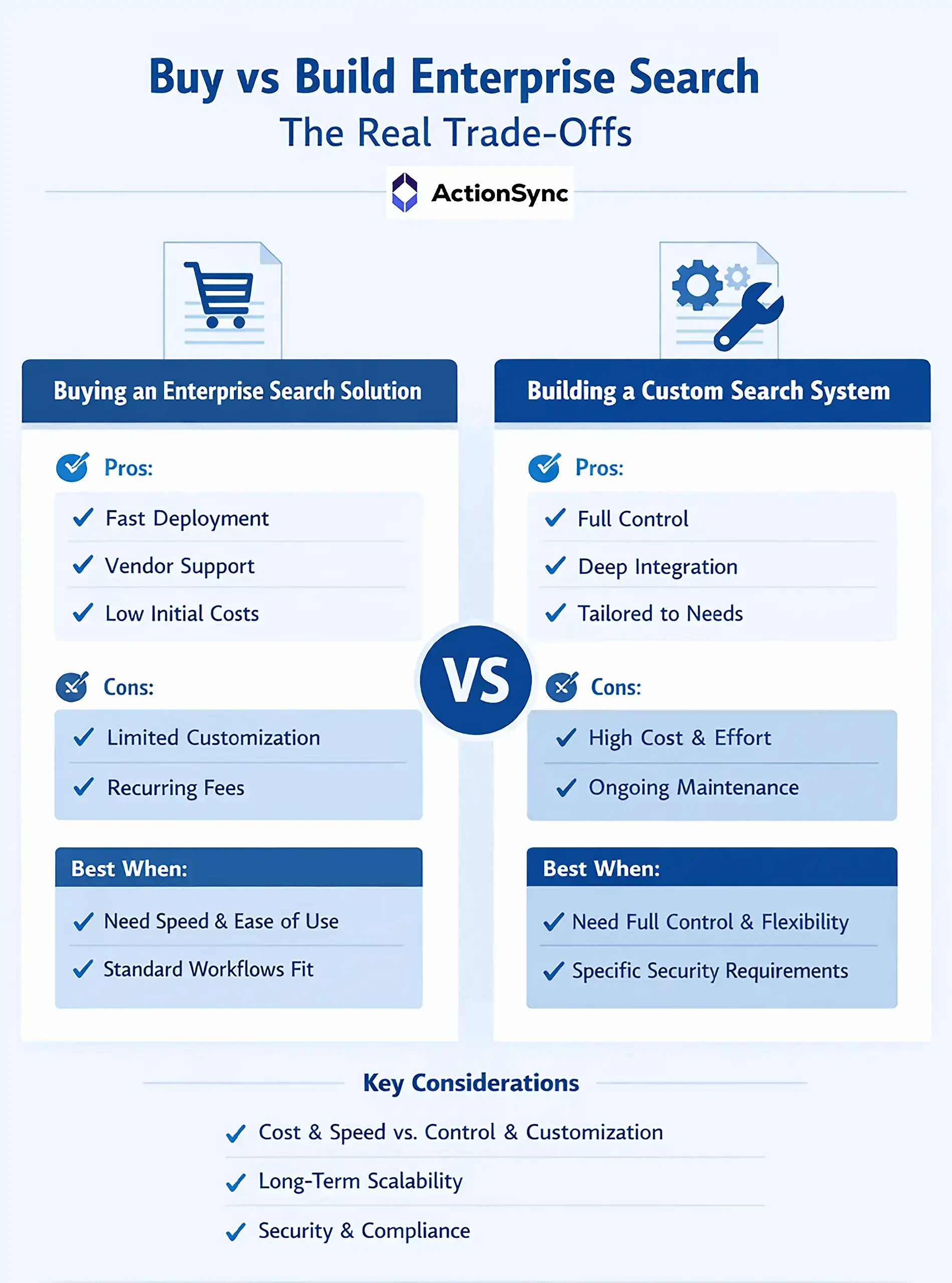
Buy vs Build Enterprise Search: The Real Trade-Offs
Now for the big fork in the road.
Buy vs build enterprise search is not a technical debate. It’s a strategic one that shapes how your organization accesses, trusts, and uses knowledge over time. The decision influences cost structures, speed of execution, control over data, and even how teams collaborate day to day.
Let’s break it down without pretending there’s a one-size-fits-all answer. The right choice depends on your scale, maturity, risk tolerance, and how central search is to your long-term strategy.
Buying an Enterprise Search Solution
Buying an enterprise search solution (like Action Sync) is often the first path companies explore, especially when search pain becomes obvious but engineering bandwidth is limited. Tools like this aggregate information across Slack, Docs, Jira, and CRMs quickly. Especially when search pain becomes obvious but engineering bandwidth is limited.
These tools promise quick wins by aggregating information across systems with minimal setup. Thereby, allowing teams to regain productivity without building everything from scratch. However, speed and convenience come with trade-offs that are important to understand upfront.
Pros:
Faster time to value
Lower upfront engineering effort
Battle-tested features
Vendor support and updates
Predictable implementation timelines
Reduced operational risk in early stages
Easier adoption due to familiar, polished interfaces
Cons:
Limited customization
Opinionated data models
Pricing that scales… aggressively
Hard constraints around security or deployment
Buying makes sense when:
Your needs are well-aligned with proven, industry-standard workflows that modern enterprise search tools handle effectively out of the box
You prioritize speed, clarity, and rapid impact, and want to deliver value quickly without the overhead of long-term system ownership
You don’t want to maintain search infrastructure, including indexing, relevance tuning, security updates, and ongoing optimization
You’re comfortable aligning internal processes to the tool, instead of shaping the tool around your processes

Building a Custom Enterprise Search System
Building a custom enterprise search system is a deliberate choice. It is often made by organizations where search is deeply tied to how work actually gets done. This path favors control, flexibility, and long-term differentiation over speed.
Instead of adapting teams to a tool’s limitations, companies design search around their data, workflows, and decision-making patterns. Thus, turning search into a strategic capability rather than a generic utility.
Pros:
Full control over data and logic
Tailored relevance and ranking
Deep integration with internal workflows
Long-term strategic asset
Cons:
High initial investment
Ongoing maintenance cost
Requires strong technical ownership
Longer time to reach initial value compared to buying
Higher dependency on internal engineering continuity
Greater responsibility for relevance tuning, security, and performance over time
Increased risk if priorities shift or key technical leaders leave
Building makes sense when:
Search is core to your product or operations, and directly impacts how teams execute, collaborate, or deliver value to customers
Off-the-shelf tools don’t meet security or compliance needs, especially in regulated environments where data control, auditability, and deployment flexibility are non-negotiable
You want the search tightly coupled with business logic
Many companies worry about the long-term lock-in cost of buying. But in practice, mature enterprise search platforms are designed to evolve with the organization. Modern vendors invest heavily in extensibility, APIs, data portability, and configurable relevance layers, which often reduces switching friction over time.
For most teams, the real risk is not lock-in. Instead, its spending years building and maintaining a system that struggles to keep pace with changing data sources, security requirements, and user expectations.
Either way, you should follow enterprise search best practices. This ensures you get the most value for your money.
What Does It Actually Mean to Build Enterprise Search?
Let’s demystify this.
When people say build enterprise search, they often imagine a single, well-defined project with a clear start and end. In reality, enterprise search is an evolving system that grows alongside the organization, its data, and its workflows. Every new tool, team, or process adds complexity that the search system must continuously absorb and adapt to.
A custom enterprise search system typically includes:
Data ingestion pipelines that pull information from multiple tools and formats
Indexing and storage layers designed to balance speed, scale, and cost
Permission and access control to ensure users only see what they are allowed to see
Ranking and relevance logic that must be tuned as usage patterns change
Search UI and APIs that fit seamlessly into existing workflows
Monitoring and feedback loops to track accuracy, performance, and user satisfaction
Taken together, these components require ongoing coordination and refinement. It’s not just engineering. It’s product thinking, long-term ownership, and a commitment to continuous improvement.
For more details, here's an article explaining the core components of enterprise search software.

The Enterprise Search Framework Mindset
Instead of thinking in terms of features, think in terms of an enterprise search framework that can scale with the organization over time. Features come and go, but a strong framework creates consistency, alignment, and clarity as data sources, users, and expectations evolve.
A solid framework answers:
What data do we index, and what data should intentionally stay out?
How fresh does it need to be to remain useful for day-to-day decisions?
Who can see what, and why, across teams, roles, and permission levels?
How do we measure success beyond usage—such as trust, accuracy, and impact?
How easily can the system adapt as new tools, teams, and data sources are added?
What level of configuration or automation is required to keep relevance high without constant manual tuning?
By grounding decisions in a framework, teams avoid chasing surface-level functionality and instead focus on long-term usability. This mindset prevents the classic failure mode: building a technically impressive system that looks powerful on paper, but quietly fails because users don’t trust it or don’t return to it.
Even smart teams stumble here. To nail this, ensure that you don't commit any of these common enterprise search mistakes.
Platforms like ActionSync already embody this enterprise search framework approach. Thus, providing scalable relevance, permissions, and data integration out of the box. So teams can focus on using knowledge, not building search pipelines.
Real-World Example: When Building Made Sense
Consider a 700-person SaaS company.
They used:
Google Workspace
Slack
Jira
Salesforce
Notion
Fireflies.ai
Keka HR
Buying enterprise search worked initially. But as workflows grew more complex, relevance suffered. Sales saw engineering docs. Engineers saw outdated GTM plans. Frustration mounted.
They decided to build a custom enterprise search system focused on role-based relevance and decision traceability.
Results after nine months:
Faster onboarding
Fewer repeated questions
Higher confidence in decisions
It wasn’t cheap. But it became a competitive advantage.

Cost Considerations: What No One Likes Talking About
Let’s address the elephant in the room.
Building enterprise search costs money, often more than teams initially expect. Buying a modern solution like Action Sync costs money too. But it often reduces hidden engineering overhead while giving teams immediate access to a reliable internal search system for companies.
The real difference lies in how those expenses show up over time. How easy they are to control. And how much internal effort they quietly consume beyond the initial decision.
Building Costs Include
Engineering time
Infrastructure
Ongoing maintenance
Opportunity cost
Security reviews, audits, and compliance overhead
Performance tuning as data volume and users scale
Knowledge loss when key engineers leave or rotate
Delayed time-to-value for end users
Internal support and troubleshooting burden
Buying Costs Include
Per-user pricing
Data volume pricing
Switching costs later
According to Forrester research, nearly half (48%) of companies prefer to buy off-the-shelf software rather than build custom applications internally. Only about 12% prefer building from scratch using custom coding, with the remainder using other development platforms.
Rule of thumb: If search is mission-critical and long-term, building often wins over time. If it’s supportive but not strategic, buying usually makes more sense.
How to Decide: A Simple Decision Framework
Ask yourself these questions honestly, without optimism bias or future assumptions:
Is search core to how we work or compete, or is it a supporting capability rather than a differentiator?
Do we have the technical maturity to own it end-to-end, including relevance tuning, security, and scale?
Are existing tools genuinely blocking us strategically, or are they simply under‑configured or under‑adopted?
Can we realistically commit to maintaining it long-term as teams, tools, and data sources change?
Do we have clear success metrics for search (trust, adoption, decision impact), or are we hoping value will emerge organically?
Are we prepared to invest in change management and adoption, not just the technology itself?
If most answers are a confident “yes,” building deserves serious consideration and a clear roadmap.
If there is hesitation, uncertainty, or mixed signals, buying (or delaying while validating needs) may be the more pragmatic and lower‑risk choice.

FAQs or Frequently Asked Questions
Q: What size company needs enterprise search?
There’s no strict headcount threshold, but companies with 50+ employees, multiple teams, and several core tools usually feel the pain most acutely. The real trigger isn’t size alone, it’s complexity. When information starts spreading across departments, tools, and time, search shifts from a convenience to an operational necessity.
Q: Is enterprise search the same as knowledge management?
Not quite. Enterprise search focuses on discovery. It helps people quickly find relevant information wherever it lives. Knowledge management focuses on structure, ownership, and governance. It aims to define what should exist, how it’s maintained, and who is responsible. Search without knowledge management creates noise; knowledge management without search creates friction. Together, they create leverage.
Q: Can we start by buying and later build?
Yes, many companies do that. But they are only successful when they plan for it early. This means understanding data portability, access controls, and relevance logic upfront. Without a migration strategy, teams often become dependent on vendor-specific models. Thus, making future transitions costly and disruptive.
Q: How long does it take to build enterprise search?
A basic, functional system can be built in 9 to 12 months, assuming a focused team and limited data sources. However, a truly effective enterprise search system is never “done.” It continuously evolves as tools change, data grows, permissions shift, and user expectations rise.
Q: Is AI required for enterprise search?
Not at the beginning. Strong enterprise search fundamentals (accurate permissions, high relevance, fresh data, and trustworthiness) matter far more than advanced models. AI becomes valuable once these basics are solid, helping with intent understanding, summarization, and proactive discovery rather than compensating for weak foundations.
Q: What usually causes enterprise search initiatives to fail?
Most failures aren’t technical. They happen due to poor adoption, unclear ownership, or unrealistic expectations. When search is treated as a side project rather than an internal product, relevance degrades quickly.
Successful teams assign clear ownership, define success metrics beyond usage, and continuously tune results based on real user behavior.
Q: How do you measure whether enterprise search is actually working?
Usage alone isn’t enough. Effective measurement includes reduced time-to-answer, fewer repeated questions, faster onboarding, and higher confidence in decisions. Qualitative signals matter too. Teams trusting search results, linking to them in discussions, and using search proactively instead of asking around.
Q: Does enterprise search create security or privacy risks?
Only if implemented poorly. A well-designed enterprise search system respects existing permissions, mirrors access controls, and avoids overexposing sensitive data. Mature platforms and frameworks treat security as foundational, not optional, making search safer than ad‑hoc sharing through chat or email.

Conclusion: So, is it Better to Build or Buy an Enterprise Search System?
Here’s the honest answer: It depends, but not in a vague or hand-wavy way.
You should build an enterprise search system when information is truly central to how your organization operates day to day, when off-the-shelf tools begin to impose real constraints, and when you’re prepared to treat search as a long-term product rather than a one-time feature rollout.
In short: Build it if data is your lifeblood, "off-the-shelf" isn't cutting it, and you're in it for the long haul.
This decision usually becomes clear when search quality starts affecting execution speed, decision confidence, and cross-team alignment. At that point, search is no longer a convenience. It becomes part of the organization’s operating system.
If you’re early, buying allows you to move fast, validate needs, and avoid premature complexity. If you’re scaling, you owe it to yourself to evaluate deeply, not just tools, but ownership, data flow, and long-term cost. And if you’re already feeling the drag of lost knowledge, repeated debates, and constant context rebuilding, then building may be one of the smartest long-term investments you make.
Search isn’t about technology alone. It’s about how your organization thinks, learns, makes decisions, and moves forward under pressure. Whether you choose to build, buy, or leverage a platform like Action Sync, the goal is the same: faster, smarter, and more confident decision-making across teams.
Curious how Action Sync can bring your company’s scattered knowledge together instantly? Book a free demo today and see how your teams can start finding answers (and context) without the friction.