Back
Work AI
What Are Knowledge Silos? Examples, Causes & Solutions

Tushar Dublish

Let’s be honest for a second. Almost every organization claims it values knowledge. Leaders talk about collaboration, alignment, transparency, and “working as one team.” Sounds great on paper, right?
But then Monday morning hits.
Someone in sales asks a simple question that marketing already answered three months ago. A product manager recreates a document that exists: somewhere. Customer support learns a hard lesson that engineering solved last quarter. Time slips away, frustration builds, and people mutter, “Didn’t we already know this?”
If that feels familiar, you’re staring straight at the issue this article is about.
So, what are knowledge silos, really? Why do they form so easily? And why do even smart, well-funded organizations struggle to eliminate them?
In this practical guide, we’ll unpack the knowledge silos meaning, explore knowledge silos in organizations, look at examples of knowledge silos in the workplace, and break down the problems caused by knowledge silos. More importantly, we’ll discuss how modern knowledge management tools are reshaping how teams share, retain, and use information. All without forcing people to change how they work overnight.
Increasingly, these platforms take the form of an enterprise AI assistant. This is a system designed to understand organizational context, connect fragmented tools, and deliver answers directly inside everyday workflows.
Many teams try to fix this by “documenting more” or adding yet another tool. But the real issue isn’t a lack of information. It’s the lack of connected, contextual access to that information across tools and teams.
This is why modern approaches focus less on storage and more on creating an intelligent layer that connects conversations, documents, and decisions wherever work already happens.
So, let's dive in.
Knowledge Silos Meaning: What Are They?
At its core, the knowledge silos meaning is simple.
A knowledge silo exists when information is trapped within a person, team, department, or system. And it isn’t easily accessible to others who need it.
Think of a literal silo on a farm. Grain goes in from the top, gets stored safely, and stays there. That’s great for corn. Terrible for organizations.
In practice, silos don’t just hide documents. They hide decisions, rationale, and institutional memory. The most valuable knowledge is often not written down at all. It lives in chats, meetings, and fleeting conversations that disappear as soon as they’re over.
When we ask, what are knowledge silos, we’re really asking:
Why does critical information live in isolated pockets?
Why can’t teams see or reuse what others already know?
Why does learning feel fragmented instead of shared?
Why do the same mistakes get repeated across teams?
Why does decision-making depend on who you ask rather than what the organization knows?
Knowledge silos aren’t always intentional. In fact, they often start with good intentions: speed, ownership, specialization. But over time, those intentions harden into barriers.
And once those barriers are in place, they quietly slow everything down.

Knowledge Silos in Organizations: Why They’re So Common?
Here’s the uncomfortable truth. Knowledge silos in organizations are the default, not the exception. They don’t appear because teams are careless or leaders are shortsighted. They emerge quietly, almost naturally, as a side effect of growth.
As companies scale, complexity creeps in. More people join. More tools are introduced. Processes multiply. Handoffs increase. Each new layer adds a little friction, and over time, that friction turns into isolation. What once felt agile and connected starts to feel fragmented.
A few common realities make silos almost inevitable:
Teams specialize in moving faster and going deeper in their domain
Tools are adopted independently to solve immediate, local problems
Information is created faster than it can be reviewed, structured, or shared
Incentives reward individual or team success, not shared organizational outcomes
Knowledge sharing is treated as optional rather than a core responsibility
Critical context lives in meetings, chats, or emails and never gets captured
There is no single source of truth that teams trust and consistently use
None of these choices is wrong on its own. In fact, many are necessary. The problem begins when these realities stack up without a unifying knowledge layer to connect them.
A unifying knowledge management layer doesn’t replace existing tools. It connects them. It allows teams to search once and see answers pulled from across Slack, documents, project tools, CRMs, and past decisions. All without needing to know where that information originally lived.
Before long, marketing has its own world. Sales lives in another. Product, engineering, HR, and finance are all swimming in oceans of data. But rarely in the same pool. Insights stay local. Context gets lost. Teams move fast, but not always in the same direction.
Nobody wakes up thinking, “Let’s build organizational knowledge silos today!” Yet that’s exactly what happens when growth outpaces alignment, and information spreads faster than the systems designed to connect it.
Organizational Knowledge Silos vs Healthy Specialization
Now, let’s pause and clarify something important.
Not all separation is bad.
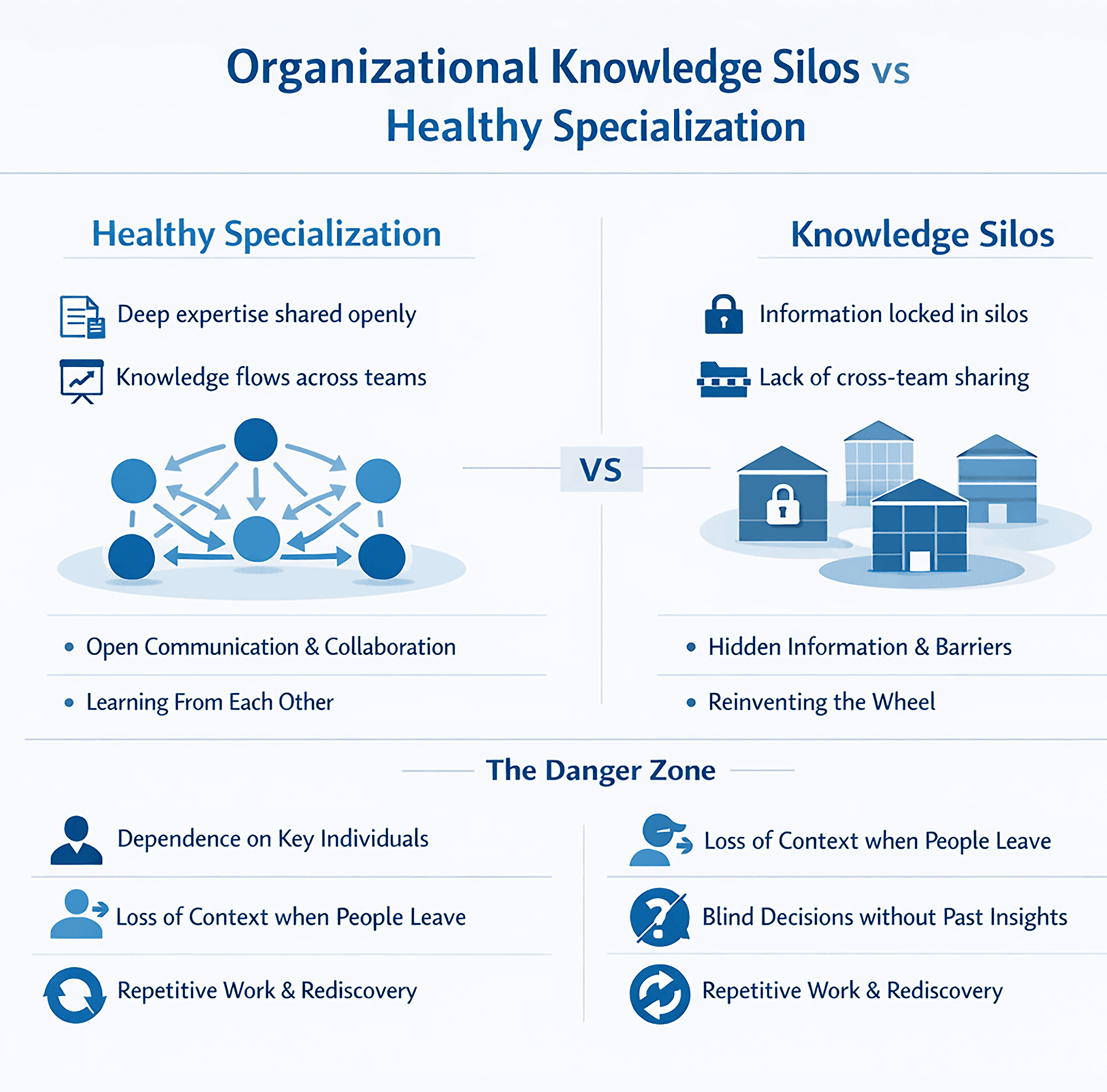
Healthy specialization allows experts to focus, go deep, and deliver quality work. Organizational knowledge silos, however, cross a line when specialization turns into isolation.
Here’s a quick way to tell the difference.
Healthy Specialization:
Teams own deep domain expertise and are accountable for decisions within their area. But they actively share outcomes, insights, and learnings across the organization.
Knowledge flows outward through documentation, demos, retrospectives, and shared systems. So other teams can reuse context, avoid repeating mistakes, and build on existing work instead of starting from scratch.
Knowledge Silos:
Teams retain information within their boundaries, either intentionally (to protect ownership or speed) or unintentionally (due to poor systems or habits).
Critical context stays locked in private documents, chats, or people’s heads. This means other teams can’t benefit from past learnings, decisions lack historical insight, and the organization repeatedly pays the cost of rediscovery.
The danger zone appears when:
Knowledge transfer depends on specific individuals
Context disappears when someone leaves
Decisions are made without visibility into past learnings
Teams repeat work because past decisions and rationale aren’t documented or discoverable
That’s when silos stop being efficient and start being expensive.
What Causes Knowledge Silos in Organizations?
If you want to fix a problem, you have to understand its roots. So let’s dig into what causes knowledge silos in organizations.
Knowledge silos usually form due to a mix of structural, cultural, and behavioral factors that compound over time. One of the biggest contributors is fragmented tooling. Modern teams work across dozens of disconnected apps (email, chat, project tools, CRMs, drives), each capturing only a slice of context. When information is spread this thin, it becomes difficult to discover later, even when it technically exists.
This is where traditional knowledge management systems break down. The issue isn’t that teams lack information. It’s that they lack a single, intelligent way to retrieve meaning across fragmented systems.
Another major driver is department-first incentives. Goals, KPIs, and rewards are often designed around local success, not organizational learning. As a result, teams optimize for speed and outcomes within their own boundaries, while cross-team knowledge sharing becomes an afterthought rather than a responsibility.
Several patterns commonly accelerate this problem:
Tacit knowledge stays locked in people’s heads instead of being externalized into shared systems
Documentation is skipped, rushed, or quickly becomes outdated under delivery pressure
Critical decisions and rationale live in meetings, chats, or inboxes and are never captured
Teams lack a trusted, easy-to-use single source of truth for past learnings
Knowledge sharing feels risky, unrewarded, or invisible in performance reviews
Over time, these conditions reinforce each other. Information becomes harder to trust, so people stop looking. They rely on asking around instead, which further concentrates knowledge in individuals. When those individuals leave or change roles, context disappears with them.
In environments where psychological safety is low and sharing feels like extra work (or worse, a threat), knowledge silos don’t just appear. They quietly thrive. Thereby, draining productivity, slowing decisions, and forces organizations to relearn the same lessons again and again.
Examples of Knowledge Silos in the Workplace
Let’s make this real with concrete examples of knowledge silos in the workplace.
Example 1: Sales and Customer Support
On the surface, things look fine. The sales team closes deals at speed, confidently promising what customers want to hear. But a few weeks later, support tickets spike. Customers are confused. Support agents scramble, only to realize they were never looped into recent sales conversations or recurring objections.
The insight does exist. Support sees the same issues every day. But there’s no clear path to feed that knowledge back into sales enablement or onboarding material. So the loop never closes.
Customers feel misled, support feels blamed, and sales feel frustrated by complaints they didn’t anticipate. One missing knowledge bridge quietly turns momentum into friction.
Example 2: Remote and Hybrid Teams
In a hybrid company, a critical decision is made during an impromptu office conversation. A whiteboard sketch, a quick verbal agreement, a sense of alignment. And then everyone moves on. Except half the team wasn’t there.
Weeks later, remote teammates question why certain decisions were made. The context is gone. The people who were present vaguely remember the reasoning, but nothing was documented.
What feels like confusion to remote employees is actually a knowledge silo formed by proximity. Not a lack of talent or effort. But a lack of captured context. Over time, this gap erodes trust, slows execution, and makes distributed teams feel like second-class participants.

7 Major Problems Caused by Knowledge Silos
Now we arrive at the real cost. The knowledge silos problems aren’t theoretical. They show up in metrics leaders care about.
1. Lost Productivity
Lost productivity is often the first and most visible cost of knowledge silos. Employees spend a surprising amount of time searching for information that already exists, recreating documents that someone else has built before, or interrupting teammates just to get basic context. Over weeks and months, this constant friction quietly eats into focus time and slows down execution across teams.
When knowledge isn’t easy to find or trust, people default to shortcuts. They rely on memory, personal notes, or informal conversations, which further concentrates information in individuals and makes the problem worse.
Solution:
Create a unified knowledge access layer that allows employees to search across tools from one place
Capture decisions and outcomes as they happen, not weeks later
Use AI-powered search and summaries so people get answers, not just documents
AI-powered knowledge management platforms like Action Sync act as this unified intelligence layer. Thus, allowing employees to ask natural questions and receive contextual answers drawn from across tools, conversations, and historical decisions, instead of hunting through folders.
2. Slower Decision-Making
When teams lack access to historical context, decision-making slows to a crawl. Leaders hesitate because they don’t know what’s already been tried. Teams debate the same topics repeatedly because past reasoning isn’t visible. In some cases, decisions move fast (but in the wrong direction) because they’re based on partial or outdated information.
Without shared context, speed becomes an illusion. What looks like agility often turns into rework.
Solution:
Document key decisions along with the rationale behind them
Make past learnings and outcomes easily discoverable, not buried in archives
Surface relevant context automatically based on role, project, or task
3. Inconsistent Customer Experiences
Customers experience knowledge silos long before leaders do. When teams don’t share insights, customers receive different answers depending on who they talk to. Promises made by sales don’t align with support responses. Product limitations aren’t clearly communicated. Over time, this inconsistency erodes trust and damages brand credibility.
What feels like a communication issue is often a knowledge access problem.
Solution:
Maintain shared customer-facing knowledge that updates in real time
Feed insights from support, sales, and success teams into a common system
Ensure frontline teams always have access to the latest product and policy context

4. Increased Risk
Siloed knowledge increases operational and compliance risk. Important policies, security practices, or regulatory requirements may live in isolated documents or with specific individuals. When that information isn’t visible, teams unknowingly expose the organization to errors, violations, or missed obligations.
Risk grows quietly when knowledge isn’t shared.
Solution:
Centralize access to policies, compliance documentation, and operational guidelines
Track updates and ownership so critical knowledge stays current
Make risk-related information searchable and easy to audit
5. Low Morale and Burnout
Knowledge silos don’t just slow work. They drain people. Employees feel frustrated when they’re left out of the loop, ignored, or forced to figure things out on their own. Over time, this leads to disengagement, burnout, and a sense that collaboration is more effort than it’s worth.
When people feel disconnected from information, they eventually feel disconnected from the organization.
Solution:
Build a culture where sharing knowledge is recognized and rewarded
Reduce dependency on individuals by capturing and sharing context broadly
Use tools that make contributing and accessing knowledge effortless
6. Poor Customer Experience Due to Fragmented Context
When knowledge is siloed, customers end up paying the price. Sales promises live in CRM notes, onboarding details sit in email threads, support history is buried in ticketing tools, and product feedback exists in Slack conversations no one revisits. The result? Customers are forced to repeat themselves, receive inconsistent answers, or experience delays because teams lack a shared view of context.
For the customer, this feels like dealing with multiple companies instead of one. For internal teams, it leads to frustration, blame-shifting, and reactive firefighting rather than proactive service. Over time, this erodes trust, increases churn risk, and turns what could have been a great customer relationship into a fragile one.
Solution:
Break knowledge silos by unifying customer information across teams.
Centralize conversations, documents, and decisions related to customers in one searchable layer
Make historical context easily accessible so any team member can act with confidence
Enable proactive insights instead of reactive ticket handling
7. Leadership Blind Spots and Slower Decision-Making
Leaders rely on accurate, timely information to make decisions, but knowledge silos distort reality. When insights are scattered across departments, leaders see fragments instead of the full picture. Metrics look good in one system while warning signs live quietly in another. Critical context gets lost as information passes through layers of summaries, decks, and secondhand updates.
This creates leadership blind spots: decisions are made too late, based on incomplete data, or without understanding the downstream impact. Teams lose confidence in leadership direction, and organizations become slower, more cautious, and less adaptive in fast-moving markets.
Solution:
Create a shared intelligence layer for decision-making.
Surface insights directly from operational tools, not just reports
Connect data, discussions, and decisions in one place
Give leaders real-time visibility into what’s happening across teams.
Instead of relying solely on lagging reports and summaries, leaders benefit from intelligence layers that connect operational data, discussions, and decisions. Thus, providing real-time visibility into how work is actually unfolding across teams.
Lastly, do note that knowledge silos rarely announce themselves loudly. They quietly slow decisions, fragment execution, and drain momentum over time. Left unchecked, they turn collaboration into guesswork and learning into repetition.
Breaking these organizational silos isn’t about forcing transparency overnight. It’s about building systems, habits, and shared spaces where knowledge naturally flows to the people who need it, when they need it. Organizations that proactively address silos don’t just work faster; they think better, adapt more quickly, and scale with far less friction. Also, following these knowledge management best practices helps in avoiding this chaos.

Why Traditional Knowledge Bases Often Fail?
Many organizations try to solve silos with static knowledge bases or internal wikis. They believe that simply documenting information will automatically make it accessible and usable across teams. These efforts often start with good intentions. Be it centralizing documents, creating folders, and encouraging employees to “check the wiki first.”
And yet… the silos persist, quietly resurfacing in meetings, Slack threads, and duplicated work.
Why? Because traditional systems:
Rely on manual updates
Lack context awareness
Are hard to search effectively
Don’t integrate into daily workflows
Become outdated almost as soon as they’re created
Depend heavily on individual ownership and discipline
Fail to surface the right information at the right moment
Encourage duplicate work instead of reuse
Break down completely as teams and tools scale
This is why newer platforms like Action Sync don’t behave like destinations. They behave like companions. Why? Because they are designed just to work quietly in the background to connect, summarize, and surface knowledge across tools without asking employees to change how they work.
If knowledge feels like a destination instead of a companion, people won’t use it. When accessing information requires deliberate effort, extra clicks, or stepping away from real work, adoption drops fast. Knowledge needs to travel with people. It should be embedded in their tools, surfaced in context, and available exactly when decisions are being made.
This is where the difference between knowledge management and information management becomes obvious. Information management is about storing files and data. Knowledge management is about helping people understand and reuse what the organization already knows, including decisions and lessons learned. When teams treat them as the same, information exists—but silos remain.
So, How Modern Knowledge Management Platforms Change the Game?
Here’s where things get interesting.
Modern knowledge management platforms don’t just store information. They bring knowledge to life. They make it relevant and easy to use while you work. This keeps information from getting stuck in old, dusty files.
Leading platforms in the market focus on:
Unified search across tools
Contextual answers instead of raw documents
AI-powered retrieval and summarization
Role-based access and personalization
Real-time indexing of conversations, files, and decisions
Proactive surfacing of insights based on user intent
Seamless integration into daily workflows (Slack, email, project tools)
Instead of asking people to remember where knowledge lives, these platforms bring knowledge directly to where people already work. All inside their daily tools, conversations, and workflows. This removes the cognitive burden of searching, switching contexts, or relying on memory to locate critical information.
For example, ActionSync focuses on connecting fragmented systems into a shared intelligence layer. Be it indexing conversations, documents, and decisions in real time, or proactively surfacing insights based on user intent rather than static searches.
At their core, many of these platforms function as an enterprise AI assistant. Bringing together search, context, and proactive insights into a single intelligence layer that works across teams.
That shift alone dismantles many organizational knowledge silos by making knowledge accessible by default. Not by effort. And therefore, it ensures that insights surface naturally at the moment decisions are made.
FAQs or Frequently Asked Questions
Q: Are knowledge silos always bad?
Not necessarily. Some level of specialization is both natural and beneficial—deep expertise often develops within focused teams. Knowledge silos become a problem when information stays locked within those teams, preventing others from learning from it or building on it. When decisions are made with partial visibility, work gets duplicated, risks go unnoticed, and organizational learning slows down.
Q: What causes knowledge silos in organizations the most?
The biggest driver is fragmentation—of tools, incentives, and ownership. Teams use different systems that don’t talk to each other, are rewarded for local success rather than shared outcomes, and lack clear responsibility for maintaining knowledge. Over time, information spreads across apps, inboxes, and conversations with no single, trusted way to access it.
Q: Can technology alone fix knowledge silos?
No. Technology is a powerful enabler, but it’s not a silver bullet. Without the right culture, incentives, and leadership behavior, even the best tools become underused repositories. Real change happens when leaders model knowledge sharing, teams are encouraged to document decisions, and technology makes these behaviors easier, not harder.
Q: How do modern platforms reduce knowledge silos?
Modern platforms focus on access, context, and timing. They unify information across tools, use AI to surface relevant insights instead of raw files, and integrate directly into daily workflows. By reducing the effort required to find, share, and reuse knowledge, they make collaboration the default rather than an extra task.
Q: What are early warning signs that knowledge silos are forming?
Some of the earliest signs are subtle. Teams repeatedly ask the same questions, onboarding takes longer than expected, and decisions depend heavily on who is present in the room. If employees say things like “Ask X, they’ll know” or “This exists somewhere,” silos are already forming.
Q: How do knowledge silos impact onboarding and employee ramp-up?
Knowledge silos dramatically slow onboarding. New hires struggle to find reliable information, rely on informal help, and miss historical context behind decisions. This increases ramp-up time, creates uneven performance, and makes new employees dependent on specific individuals rather than shared systems.
Q: How do knowledge silos affect innovation?
Innovation suffers when teams can’t see what others have tried, learned, or failed at. Ideas get reinvented, experiments are repeated, and cross-team insights never compound. Shared knowledge accelerates innovation by enabling teams to build on existing knowledge rather than starting from zero.
Q: Can AI make knowledge silos worse if implemented poorly?
Yes. If AI is layered on top of fragmented systems without unifying access or context, it can reinforce silos by giving incomplete or biased answers. AI works best when it connects sources, preserves context, and makes organizational knowledge transparent rather than opaque.
Q: What’s the first practical step to breaking knowledge silos?
Start by making knowledge easier to access than asking around. Unify search across tools, capture decisions as they happen, and remove friction from documentation. Small improvements in access and visibility often create immediate behavior change.

Conclusion
Knowledge silos don’t form because organizations don’t care about information. They form because growth, speed, and complexity outpace the systems designed to connect people and context. Left unchecked, silos quietly tax productivity, slow decisions, weaken customer trust, and limit an organization’s ability to learn from itself.
The organizations that move ahead aren’t the ones with more documents or stricter processes. They’re the ones that make knowledge easy to access, hard to lose, and naturally embedded into daily work. By focusing on shared context, unified access, and timely insights, teams stop relearning the same lessons and start compounding intelligence over time.
Enterprise search software like ActionSync shows what’s possible when organizations stop treating knowledge as static content and start treating it as living intelligence—accessible, contextual, and always available where work happens.
Breaking knowledge silos isn’t a one-time initiative. It’s an ongoing commitment to helping people find what they need, when they need it, without friction. And when knowledge flows freely, alignment follows, decisions sharpen, and organizations scale with far less resistance.
👉 Ready to move beyond static knowledge bases? Book a FREE demo of Action Sync and see how growing organizations break silos and scale shared intelligence, effortlessly.