Back
Work AI
What is Knowledge Management? Explained

Tushar Dublish

Let’s be honest for a second. Every organization talks about knowledge, but very few truly manage it well. Files are scattered, answers live inside people’s heads, teams repeat the same mistakes, and when someone leaves, a chunk of critical know-how quietly walks out the door with them. Sound familiar? That’s exactly where the conversation around what is knowledge management begins.
Knowledge management isn’t a buzzword cooked up by consultants in a boardroom. It’s a practical discipline, born from a simple need: helping people find the right information at the right time, without frustration. When done right, it saves time, reduces errors, improves decisions, and frankly, keeps teams sane.
In this guide, we’ll explore the meaning of knowledge management, and how systems actually work in the real world.
What is Knowledge Management?
At its core, knowledge management is really asking one thing: How do we capture what we know, organize it properly, and make it useful for others?
Knowledge management (often shortened to KM) is the process of creating, collecting, structuring, sharing, and maintaining knowledge within an organization. It ensures that information doesn’t sit idle, get buried in silos, or disappear when people change roles, but instead flows smoothly to the people who need it, exactly when they need it.
Done well, it transforms scattered information into a reliable foundation for everyday decisions, problem-solving, and long-term strategy.
In practice, this means moving beyond static repositories. AI knowledge management platforms like Action Sync act as an intelligence layer on top of existing tools, connecting documents, conversations, and workflows so knowledge isn’t just stored, it’s actively used.

In simpler terms:
It’s about turning information into usable knowledge that teams can actually apply in real situations
It’s about avoiding repeated work and repeated mistakes by learning once and reusing those lessons everywhere
It’s about making expertise accessible, not hidden, so knowledge isn’t locked inside a few individuals’ inboxes or heads
It’s about creating consistency and clarity across teams, processes, and decisions
And no, it’s not just about storing documents in folders and calling it a day. True knowledge management focuses on context, relevance, and usability, ensuring that information stays accurate, easy to find, and genuinely helpful as the organization grows and changes.
Knowledge Management Meaning
It becomes clearer when we split it into its core elements and look at how each one plays a distinct role.
Knowledge Creation – Generating new insights, ideas, learnings, and best practices through experience, research, experimentation, and collaboration
Knowledge Capture – Documenting what people know before it disappears, whether that knowledge lives in meetings, inboxes, processes, or people’s heads
Knowledge Organization – Structuring information so it makes sense later, using categories, tags, hierarchies, and context to improve discoverability
Knowledge Sharing – Making knowledge easy to access and reuse across teams, roles, and locations without friction or repeated requests
Knowledge Maintenance – Keeping content updated, relevant, and accurate so teams can trust what they find and rely on it with confidence
Think of it like a living library rather than a dusty archive. Books aren’t just stored on shelves; they’re carefully cataloged, regularly updated, thoughtfully recommended, and actively reused.
Without this structure and ongoing care, knowledge quickly becomes outdated, fragmented, and overwhelming. Instead of empowering people, it turns into noise that slows work down.

Types of Knowledge You’re Managing (Yes, There Are Different Kinds)
Not all knowledge is created equal. Some knowledge is easy to document and share, while other forms are deeply personal, experience-driven, or informal.
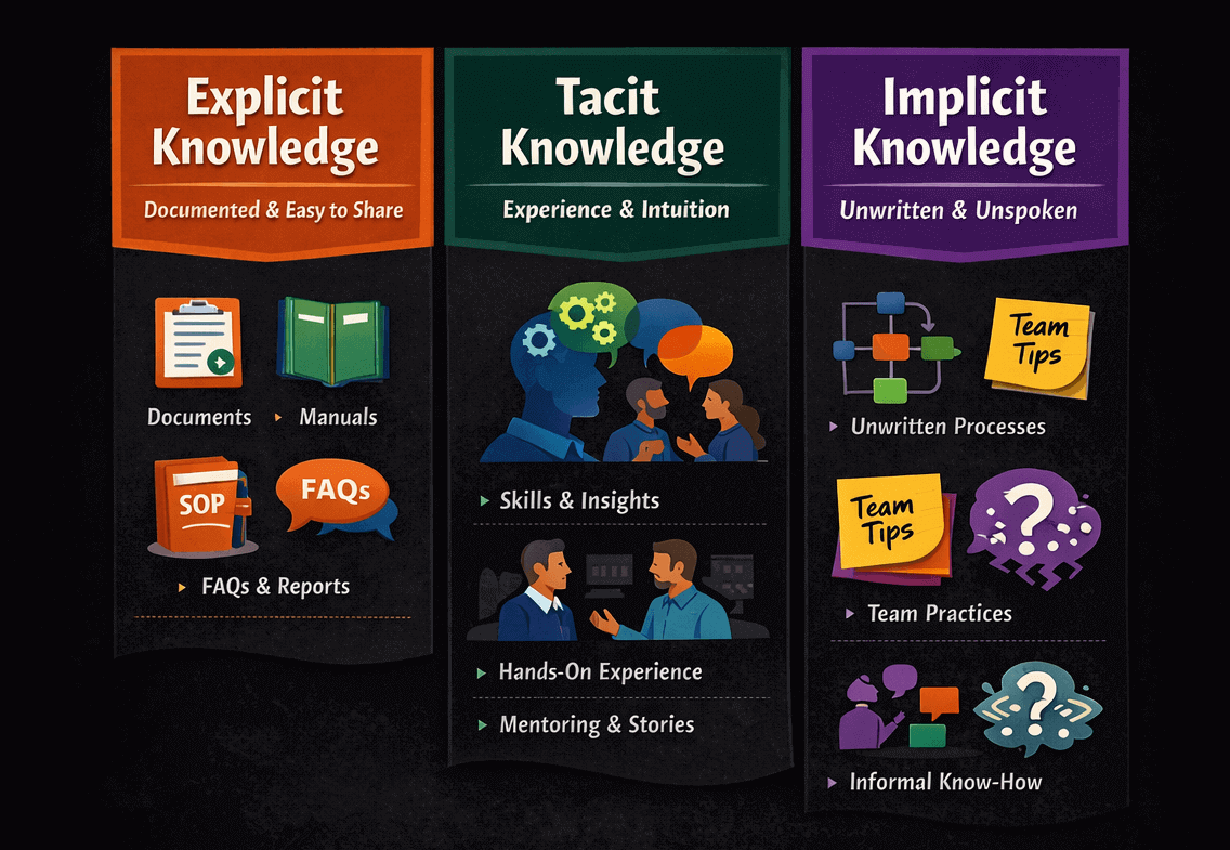
Effective knowledge management recognizes these differences and acknowledges that each type of knowledge needs to be handled in a slightly different way. That’s why most KM frameworks clearly identify three main types:
1. Explicit Knowledge
This is the easiest type of knowledge to manage and scale across an organization. Because it’s already documented, it can be stored, searched, updated, and shared with relatively little effort. Explicit knowledge typically includes:
Documents
Manuals
SOPs
FAQs
Reports
These assets form the backbone of most knowledge bases, intranets, and help centers. If it’s written down, structured, and easy to retrieve, it falls under explicit knowledge. Thus, making it the most straightforward starting point for any knowledge management initiative.
2. Tacit Knowledge
This one’s tricky. Tacit knowledge lives in people’s heads and is shaped by years of hands-on experience, trial and error, and real-world decision-making. It’s the kind of knowledge people use instinctively, often without even realizing they’re applying it:
Experience built over time through repeated situations
Intuition that guides quick decisions when there’s no clear rulebook
Problem-solving skills developed by handling complex or unexpected issues
Judgment calls that rely on context, nuance, and professional insight
Because tacit knowledge isn’t naturally written down, capturing it takes deliberate effort. Organizations often rely on interviews, shadowing sessions, walkthroughs, videos, mentoring, and close collaboration to surface this knowledge and make it shareable. When done well, it prevents critical expertise from being lost and helps newer team members learn faster.
AI-driven systems like Action Sync help bridge this gap by capturing knowledge from real work (meetings, chats, decisions, and workflows, etc). Thus, making tacit insights discoverable without forcing teams to document everything upfront manually.
3. Implicit Knowledge
This sits between explicit and tacit knowledge. It’s knowledge that could be documented but hasn’t been yet, often because it feels informal, routine, or too obvious to write down. Examples include undocumented workflows, team-specific shortcuts, unwritten rules, or tribal practices that people learn simply by being around long enough.
Implicit knowledge is especially risky because it usually goes unnoticed until it’s lost. When key employees leave or teams scale quickly, this kind of knowledge tends to disappear first, creating gaps and confusion.
A solid KM strategy addresses all three types of knowledge deliberately. Thus, ensuring nothing critical is left undocumented or dependent on memory alone.
Here's a detailed deep dive on implicit vs explicit vs tacit knowledge for your reference.
Why Knowledge Management Matters More Than Ever?
You might wonder, isn’t Google enough? Not quite. While search engines are great for finding general information, they don’t understand your organization’s context, processes, or decisions. Google can tell you what something is, but it can’t reliably tell your team how things are done here.
Modern organizations are operating in environments that are:
Remote or hybrid, with teams spread across locations and time zones
Fast-moving, where decisions are made quickly and information changes often
Tool-heavy, with knowledge scattered across apps, chats, docs, and dashboards
People-dependent, where critical know-how often lives with a few key individuals
Without a clear knowledge system in place, teams lose hours every week searching for answers, repeating questions, or recreating work that already exists. Onboarding stretches from weeks into months, productivity drops, and important decisions are made using partial, outdated, or inconsistent information.
The benefits of strong knowledge management go beyond simple organization. When done well, it creates real business impact:
Faster onboarding, so new hires become productive sooner
Better decision-making, backed by shared context and reliable information
Reduced dependency on individuals, lowering risk when people change roles or leave
Improved customer support, with quicker, more accurate responses
Higher productivity, as teams spend less time searching and more time executing
In short, knowledge management keeps organizations from tripping over their own information. Instead of slowing teams down, knowledge becomes an asset that supports clarity, speed, and confidence across the business.
So, What is a Knowledge Management System (KMS)
A knowledge management system (KMS) is the technology that supports knowledge management processes across an organization. It’s the central platform where knowledge lives, evolves over time, and gets shared across teams without friction. Instead of information being scattered across emails, chats, and personal folders, a KMS consolidates everything in a single, reliable, searchable space. This is quite similar to enterprise search.
A good KMS typically includes:
Centralized knowledge storage that acts as a single source of truth
Powerful search to help users find answers quickly and accurately
Access control and permissions to ensure the right people see the right information
Version history to track changes and maintain content accuracy
Collaboration features such as comments, mentions, and shared editing
Analytics and usage insights to understand what knowledge is being used and what’s missing
However, tools alone don’t solve the problem. A KMS only works when paired with the right culture and processes. Teams must be encouraged to document, update, and reuse knowledge regularly. Without clear ownership, habits, and accountability, even the best system risks becoming just another place where information goes to sit unused.
Modern KMS tools are also evolving into intelligent systems. For example, Action Sync AI augments traditional knowledge bases with conversational AI, proactive insights, and cross-tool awareness. So knowledge feels less like a database and more like a helpful teammate.
Key Features of an Effective Knowledge Management System
Not all systems are created equal. While many tools claim to support knowledge management, only a few are truly designed to make knowledge easy to find, use, and maintain over time. The best systems share a set of essential traits that directly influence whether teams actually adopt and rely on them:
Ease of Use – If it’s hard to use, people won’t use it. A good system feels intuitive from day one, requiring little training or explanation
Fast Search – Answers should appear in seconds, not minutes, helping users find relevant information without digging through endless pages
Clear Structure – Logical categories, hierarchies, and navigation that help users understand where knowledge lives and how it’s organized
Collaboration Tools – Comments, mentions, and shared editing that allow teams to build, improve, and refine knowledge together
Governance Controls – Clear ownership, approvals, and update workflows that keep content accurate, trusted, and up to date
Scalability – The ability to grow with your organization, supporting more users, content, and complexity without breaking down
If your system lacks these qualities, knowledge friction creeps in quickly. People stop trusting what they find, revert to asking the same questions repeatedly, and the system slowly turns into clutter instead of a source of clarity. For clarity, here's a comparison between information management and knowledge management.
Common Use Cases for KMS
Knowledge management system shows up everywhere in day-to-day work. Often in ways teams don’t immediately notice until something breaks or slows them down:
Customer Support – Help centers, internal playbooks, response templates, and troubleshooting guides that help agents resolve issues faster and more consistently
HR & Onboarding – Policies, training materials, role guides, and onboarding checklists that help new hires ramp up without constant hand-holding
Engineering & IT – Technical documentation, runbooks, incident reports, and architectural notes that keep systems reliable and teams aligned
Sales & Marketing – Battle cards, messaging frameworks, case studies, and campaign learnings that ensure consistent communication and smarter selling
Operations – Process documentation, SOPs, compliance records, and workflows that keep everyday business running smoothly
Product Management – Product requirements, decision logs, roadmaps, and release notes that preserve context and align teams across planning and execution
Legal & Compliance – Policies, regulatory guidelines, contract templates, and audit trails that reduce risk and ensure consistent adherence to rules
Finance & Procurement – Budget guidelines, approval workflows, vendor documentation, and financial playbooks that support accurate decisions and controlled spending
Different teams may use knowledge in different ways, but the goal is always the same: clarity. When information is easy to find and trust, teams move faster, make fewer mistakes, and collaborate with far less friction.
Knowledge management software is getting smarter. AI-powered search, automated tagging, and conversational interfaces are changing how people interact with information. Still, the fundamentals remain the same: clarity, access, and trust.
Technology evolves. Human needs don’t.

FAQs or Frequently Asked Questions
Q: What is knowledge management in simple words?
Knowledge management is the practice of organizing, storing, and sharing what an organization knows so people can easily find the right information and use it in their day-to-day work. Instead of relying on memory, guesswork, or repeated questions, teams use documented knowledge to work faster, make better decisions, and avoid common mistakes.
Q: What is a knowledge management system used for?
A knowledge management system is used to store, structure, search, and share organizational knowledge in one central place. It helps teams access accurate information quickly, maintain consistency, reduce duplicated effort, and ensure that important knowledge is not lost when people change roles or leave the organization.
Q: Is knowledge management only for large companies?
Not at all. While large organizations rely on knowledge management to handle scale and complexity, small teams often benefit even more. With fewer people and limited time, having clear, accessible knowledge helps small teams move faster, onboard new hires easily, and operate without constant interruptions or dependency on a single person. Here are some knowledge management best practices with examples that you could use.
Q: How often should knowledge be updated?
Knowledge should be updated continuously, not just once in a while. As processes change, tools evolve, and teams learn new lessons, documentation must be reviewed and refreshed regularly. Outdated or inaccurate knowledge can slow teams down and lead to poor decisions, which is why ongoing maintenance is a critical part of knowledge management.
Q: Can AI help with knowledge management?
Yes, AI plays a growing role in modern knowledge management. It can improve search accuracy, summarize long documents, recommend relevant content, and surface insights based on usage patterns. When used thoughtfully, AI helps teams find answers faster and makes large knowledge bases easier to navigate and maintain.
Tools like Action Sync demonstrate how AI can move beyond just search. How? Simply by connecting insights across systems, preserving institutional memory, and reducing the everyday friction caused by scattered knowledge.
Conclusion
So, what is knowledge management really about? At its heart, it’s about respect for people’s time, intelligence, and effort. It’s about recognizing that knowledge is one of the most valuable assets an organization has, and treating it with the care it deserves. By turning scattered information into shared understanding, knowledge management helps teams spend less time searching, less time guessing, and more time doing meaningful work.
When organizations get knowledge management right, the impact is visible across every function. Work flows more smoothly, decisions are grounded in context rather than assumptions, and teams feel empowered because they know where to find answers and how to contribute their own insights. Knowledge stops being a bottleneck and starts becoming a multiplier.
Whether you’re just starting out or refining an existing system, remember this: knowledge only creates value when it’s actively used, shared, and maintained. A well-managed knowledge base doesn’t just store information, it supports learning, consistency, and growth over time. Manage it well, and everything else gets easier. Almost magically.