Back
Insights
Different Types of Knowledge: Implicit, Tacit, and Explicit Explained

Tushar Dublish

Knowledge is a funny thing. You use it every single day, often without realizing it. You tie your shoes, sense tension in a meeting, explain a process to a colleague, or follow a checklist at work. And boom, knowledge is in action. Yet, when someone asks, “What kind of knowledge is that?”, many people freeze. Don’t worry, you’re not alone.
In business, education, and everyday life, understanding types of knowledge isn’t just academic fluff. It’s practical, powerful, and surprisingly human. Organizations grow or collapse based on how well they recognize, share, and protect knowledge. Individuals succeed when they know what they know and how to use it.
In modern organizations, the real challenge isn’t a lack of knowledge. It’s fragmentation. Knowledge exists, but it’s scattered across tools, teams, and conversations. This gap between knowing and doing is where many teams struggle. And exactly where knowledge management systems like Action Sync are designed to help reconnect knowledge with execution.
This article dives deep into three core forms of knowledge: implicit, tacit, and explicit. We’ll unpack what they mean, how they differ, why the debates around implicit vs tacit knowledge, tacit vs explicit knowledge, and implicit vs explicit knowledge matter, and how all this plays out in real workplaces.
Let’s get into it.
Understanding Knowledge Beyond Definitions
Before we slice knowledge into categories, let’s pause for a second. Knowledge isn’t just information. It’s not a PDF, a spreadsheet, or a training video. Knowledge is information plus experience, judgment, and context. That’s the secret sauce.
Think of it this way:
Information tells you what
Knowledge tells you how and why
Wisdom tells you when
Most confusion around knowledge classification happens because people lump everything together. But not all knowledge behaves the same way. Some knowledge hides in habits. Some lives in documents. Some exists only in people’s heads.
That’s where implicit, tacit, and explicit knowledge come in.

Main Types of Knowledge
At a high level, most modern frameworks agree on three primary workplace knowledge types that shape how individuals think, act, and perform at work:
Implicit knowledge
Tacit knowledge
Explicit knowledge
These categories aren’t rigid boxes or isolated knowledge silos. In real life, they constantly overlap, influence one another, and evolve over time.
Implicit insights can mature into tacit expertise, and tacit understanding can sometimes be translated into explicit documentation.
Still, understanding where one type generally begins, and another ends is cruciaL. Especially when designing effective knowledge management types for teams or organizations that actually reflect how people work.
When leaders fail to recognize these distinctions, they often overinvest in tools and underinvest in people. When they get it right, learning accelerates, decisions improve, and knowledge flows instead of getting stuck.
Let’s break them down one by one.
What is Implicit Knowledge? Explained.
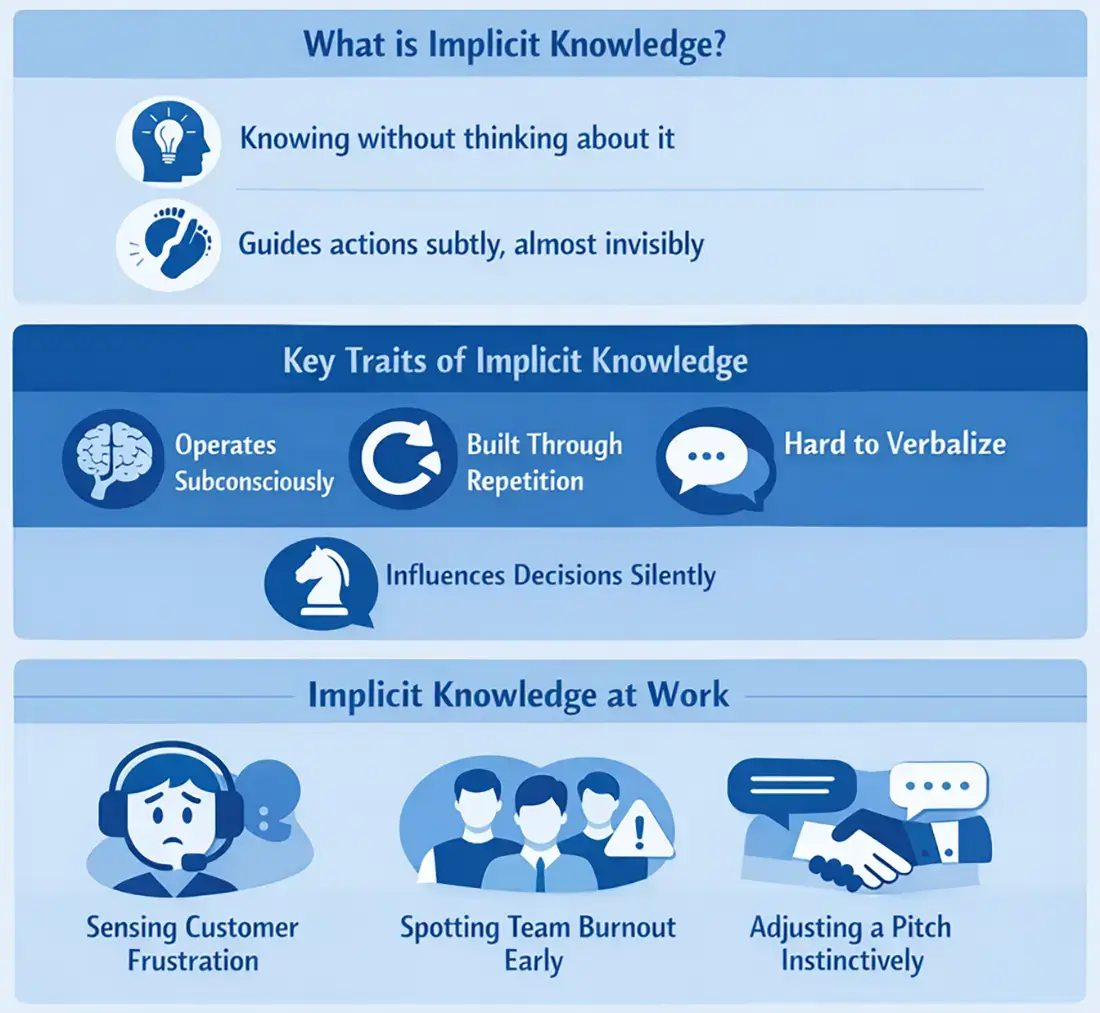
Implicit knowledge is the kind of knowledge you have, but haven’t consciously articulated. It guides your actions quietly, almost invisibly. You may not even realize you possess it—until it’s missing.
In simpler terms, implicit knowledge is what you know without actively thinking about it.
An implicit knowledge example could be your ability to maintain balance while walking. You don’t recite physics formulas in your head. You just… walk.
In organizations, implicit knowledge often shows up as intuition, pattern recognition, or “gut feel.”
Key Characteristics of Implicit Knowledge
Implicit knowledge has a few defining traits:
It operates subconsciously
It develops through repetition and exposure
It’s hard to verbalize
It influences decisions silently
Dangling from experience, shaped by time, implicit knowledge often goes unnoticed. Yet, it’s incredibly powerful.
Implicit Knowledge Example in the Workplace
Imagine a customer support agent who instantly senses when a caller is about to escalate, even before harsh words are spoken. They adjust their tone, slow down, and defuse the situation.
That’s not in the training manual. That’s implicit knowledge at work.
Other workplace examples include:
A manager sensing team burnout early
A designer instinctively knowing when a layout feels “off”
A salesperson adjusting their pitch mid-conversation
In discussions around implicit vs tacit knowledge, this subtlety is where confusion begins.
While implicit knowledge can’t be fully documented, it often leaves traces. In decisions made, actions taken, and patterns repeated over time. Systems like Action Sync help teams observe and learn from these patterns. Thus, making invisible knowledge more visible without forcing it into rigid documentation.
Pro Tips
Want to make implicit knowledge visible?
Ask reflective questions like “How did you know that?”
Observe behavior, not just outcomes
Encourage storytelling in teams
You won’t fully document implicit knowledge, but you can recognize and respect it.
What is Tacit Knowledge? Explained.
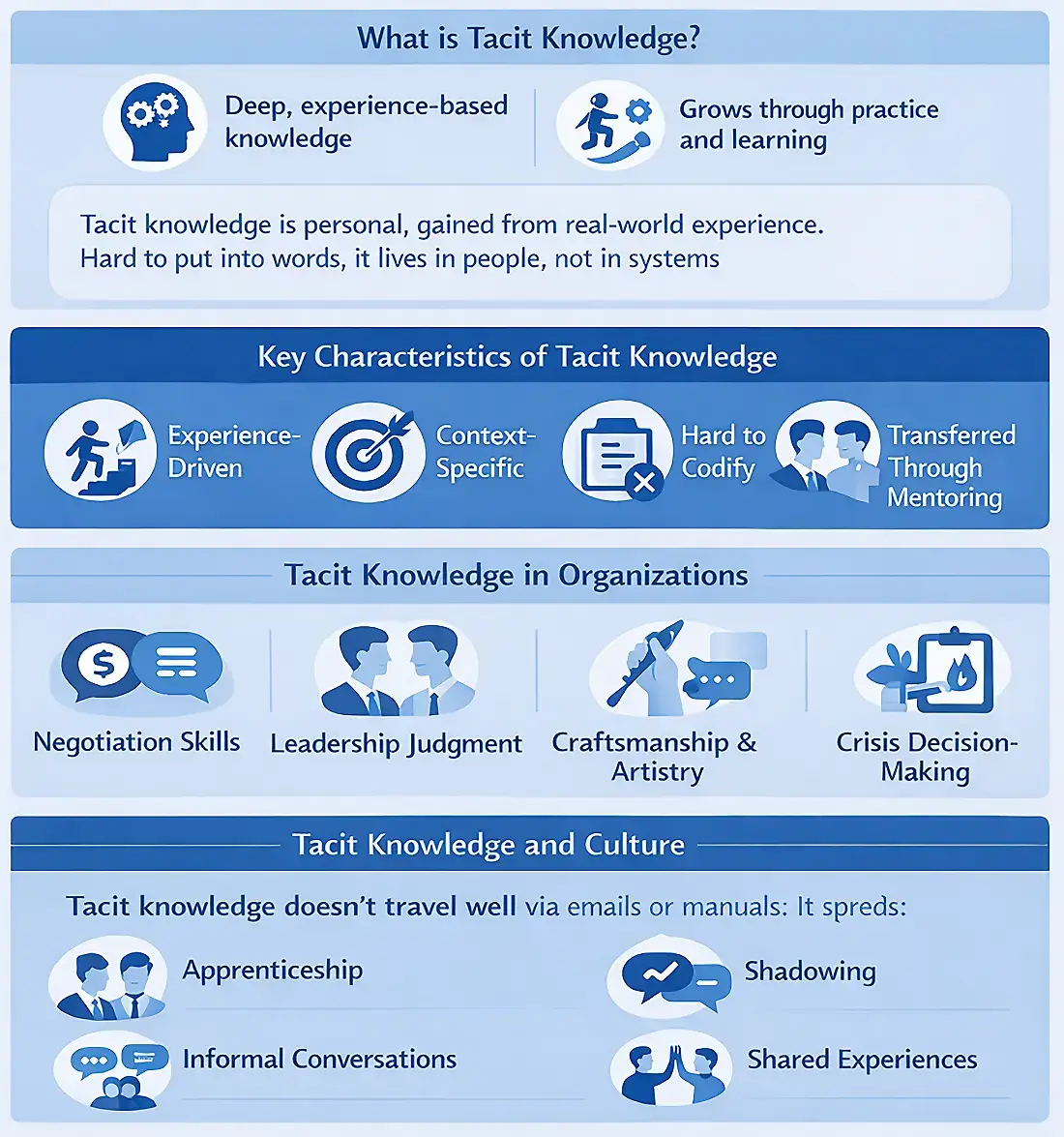
Tacit knowledge is deeply personal, experience-based knowledge that’s difficult—but not impossible—to explain. It lives in people, not in systems or documents, shaped slowly by years of doing, failing, adjusting, reflecting, and learning in real-world situations. This type of knowledge grows quietly over time and becomes part of how a person thinks, reacts, and makes decisions.
If implicit knowledge is subconscious and automatic, tacit knowledge is consciously known but hard to articulate. You’re aware that you know it, and you rely on it regularly, yet putting it into clear words often feels frustrating or incomplete. Something always seems to get lost in translation.
A classic tacit knowledge example? Riding a bicycle. You can explain the steps—balance, pedaling, steering—sure. But real mastery comes only through practice, repetition, and experience. No amount of written instruction can replace the moment your body finally understands what to do.
Key Characteristics of Tacit Knowledge
Tacit knowledge tends to be:
Experience-driven
Context-specific
Hard to codify
Transferred through observation and mentoring
This is where debates around tacit vs explicit knowledge really heat up.
Tacit Knowledge Example in Organizations
Consider a senior engineer who can diagnose a system failure by “listening” to logs and metrics. They can’t fully explain how they know—but they know.
Other examples include:
Negotiation skills
Leadership judgment
Craftsmanship and artistry
Crisis decision-making
This is the goldmine of organizational knowledge types.
Tacit Knowledge and Culture
Tacit knowledge doesn’t travel well via emails or manuals. It spreads through:
Apprenticeship
Shadowing
Informal conversations
Shared experiences
Lose your people, and you often lose this knowledge too. That’s why retention matters more than you think.
This is where modern knowledge systems matter. Enterprise search tools like Action Sync don’t replace mentoring or human learning. But they help retain decision context, shared understanding, and action history so that critical tacit knowledge doesn’t disappear when people move on.
Pro Tips
To unlock tacit knowledge:
Pair juniors with seniors
Use after-action reviews
Encourage “show, don’t tell” learning
You can’t force tacit knowledge into documents—but you can create environments where it flows.
What is Explicit Knowledge? Explained.
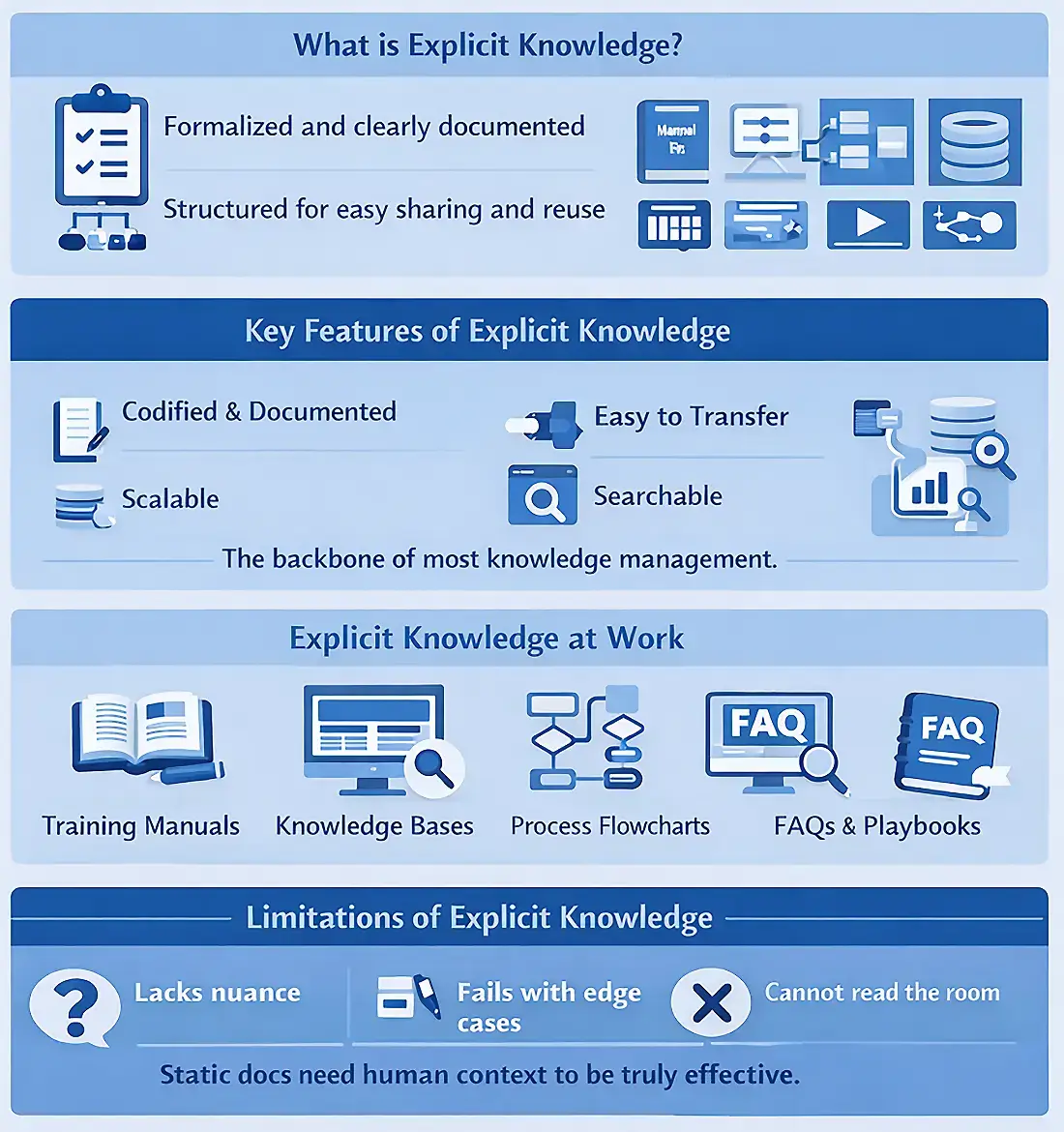
Explicit knowledge is the easiest type of knowledge to spot, store, and share across individuals, teams, and entire organizations. It’s formalized, carefully documented, and deliberately structured so that it can be accessed without relying on personal memory or direct human interaction. This makes explicit knowledge especially valuable in fast-growing or distributed workplaces.
Policies, manuals, SOPs, videos, databases, handbooks, checklists, and internal wikis, etc. All of these count as explicit knowledge because they capture information in a fixed, repeatable format. Once created, this knowledge can be reused again and again, even when the original creator is no longer present.
An explicit knowledge example could be a step-by-step onboarding guide that explains company tools, processes, and expectations in clear language. It could also include screenshots, templates, or short videos, making it easier for new employees to learn quickly and consistently.
Key Features of Explicit Knowledge
Explicit knowledge is:
Codified and documented
Easy to transfer
Scalable
Searchable
This is the backbone of most knowledge management types.
Explicit Knowledge Example at Work
Examples include:
Training manuals
Knowledge bases
Process flowcharts
FAQs and playbooks
When people discuss implicit vs explicit knowledge, this is usually the “explicit” side they mean.
Limitations of Explicit Knowledge
Here’s the catch: explicit knowledge lacks nuance. It doesn’t adapt well to edge cases. It can’t read the room.
Over-reliance on documentation without human context? That’s a recipe for frustration.
This limitation is exactly why organizations are moving beyond static documentation. AI enterprise assistants such as Action Sync focus on linking explicit knowledge with real decisions and actions. Thus, ensuring that documented information actually drives outcomes instead of sitting unused in repositories.
Pro Tips
To make explicit knowledge more effective:
Keep it updated
Use simple language
Add examples and visuals
Link it to real-world scenarios
Documentation should serve people, not scare them away.
Implicit vs Tacit vs Explicit Knowledge: A Clear Comparison
Let’s put it all together. The differences between implicit tacit and explicit knowledge become clearer when viewed side by side.
Aspect | Implicit Knowledge | Tacit Knowledge | Explicit Knowledge |
Awareness level | Subconscious and automatic | Consciously known but hard to express | Fully conscious and articulated |
How it develops | Through repetition and exposure | Through experience and practice | Through documentation and formal learning |
Ease of explanation | Very difficult to explain | Difficult but possible | Easy to explain and record |
Typical location | Habits, intuition, instincts | People’s minds and experiences | Documents, systems, databases |
Transfer method | Observation and immersion | Mentoring, shadowing, storytelling | Manuals, guides, training materials |
Workplace example | Sensing tension in a meeting | Negotiating a complex deal | Following an SOP or checklist |
Risk if lost | Subtle performance decline | Major expertise loss | Temporary disruption |
So, why do these differences matter? Well, in organizations, misunderstanding these categories leads to broken systems. You can’t document everything. You can’t mentor everything either.
Effective organizations don’t try to force all knowledge into one format. Instead, they use systems like ActionSync to respect each knowledge type while enabling smoother movement between intuition, experience, and execution.
Balance is the key.
Even better? Make sure you follow these knowledge management best practices & tips.

FAQs or Frequently Asked Questions
Q: What are the main types of knowledge?
The main types of knowledge are implicit, tacit, and explicit. Together, they explain how humans and organizations think, learn, and act. Implicit knowledge operates in the background as intuition and habit, tacit knowledge develops through experience and expertise, and explicit knowledge is captured in documents and systems.
Understanding all three helps organizations avoid treating knowledge as just information management and instead manage it as a living capability.
Q: What is the difference between tacit vs explicit knowledge?
The key difference lies in how the knowledge is expressed and transferred. Tacit knowledge is gained through hands-on experience and is difficult to put into words, such as leadership judgment or problem-solving instincts.
Explicit knowledge, on the other hand, is clearly documented and easy to share, like manuals, SOPs, or training guides. Organizations often scale explicit knowledge easily, but tacit knowledge is what gives people depth and mastery.
Q: Can implicit knowledge become explicit?
In some cases, yes. Implicit knowledge can be surfaced through reflection, observation, and repeated practice. For example, when someone pauses to explain why they made a certain decision instinctively, part of that implicit understanding may become explicit.
However, implicit knowledge is often incomplete when documented because it relies heavily on context and subconscious cues that are hard to fully capture.
Q: Why is tacit knowledge important in organizations?
Tacit knowledge is critical because it represents real expertise. It drives innovation, sound judgment, and effective decision-making, especially in complex or uncertain situations.
When experienced employees leave without transferring their tacit knowledge, organizations don’t just lose people. They lose problem-solving ability, efficiency, and competitive advantage.
Q: How can organizations manage all three types of knowledge effectively?
Organizations need more than documentation tools. They need systems that connect knowledge with decisions and actions. Enterprise assistant platforms like Action Sync are designed to support this by bridging explicit documentation, tacit experience, and real-world execution. All without forcing everything into manuals or meetings.
Q: How do workplace knowledge types affect performance?
Workplace performance improves when all knowledge types are acknowledged and supported. Explicit knowledge ensures consistency and efficiency, tacit knowledge enables expertise and adaptability, and implicit knowledge supports quick, intuitive decision-making.
When organizations balance these workplace knowledge types, teams collaborate better, respond faster to change, and deliver stronger outcomes.

Conclusion
Knowledge isn’t static. It’s alive, evolving, and deeply human. It shows up in instincts, experience, conversations, documents, and everyday decisions. Understanding the types of knowledge (implicit, tacit, and explicit) allows us to design better workplaces, learn more effectively, and collaborate with far greater intent and clarity.
The real magic happens when we stop treating knowledge as just content to be stored and start seeing it as a living system to be nurtured. A system that grows through people, practice, reflection, and shared purpose. The one that weakens when context, experience, or trust is ignored. This shift (from storing knowledge to activating it) is the philosophy behind platforms like ActionSync, which aim to turn scattered understanding into coordinated action.
When organizations and individuals get this balance right, knowledge stops being a bottleneck and starts becoming a multiplier. Decisions improve, learning accelerates, and work feels more connected and meaningful.
And yes, that’s knowledge in action.
👉 Your knowledge is everywhere: documents, conversations, tools, and people. ActionSync AI connects it all and turns insight into execution. Book a FREE demo and see how modern teams work smarter.