Back
Insights
15 Change Management Best Practices Backed by Data

Tushar Dublish

Change is everywhere. New AI tools. New systems. New org structures. New expectations from customers and employees alike. Yet most organizations are still getting it wrong, often repeating the same patterns despite better technology and more data than ever before.
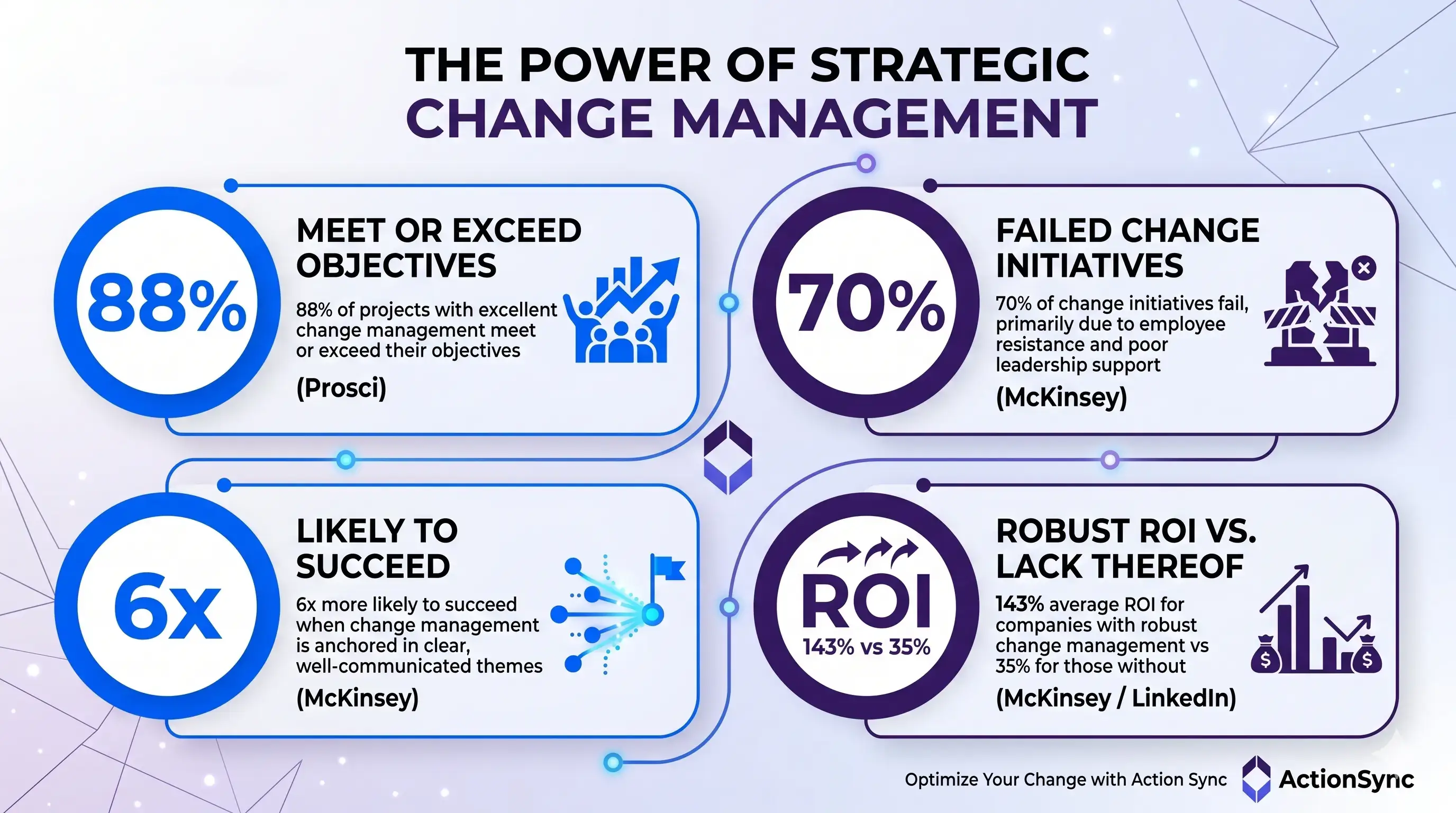
Here is the uncomfortable truth: 70% of change initiatives fail. Not because the strategy is bad. Not because the technology is wrong. They fail because the human side of change gets treated as an afterthought. According to McKinsey, the top causes are employee resistance and insufficient leadership support. These are two very fixable things, yet consistently underestimated in planning and execution.
The good news? The organizations that get change right do not have some secret framework. They follow a consistent set of proven practices. Some are simple. Some are harder than they look. All of them matter. And more importantly, they apply them with discipline, not just intent.
This guide breaks down the most effective change management best practices, with real examples, pro tips, and practical steps you can use starting today. Whether you are leading a digital transformation, rolling out an AI tool, or restructuring teams, these principles will help you move from rollout to real adoption.
Why Change Management Still Fails in 2026
Before the list, one honest answer to that question.
Change is hard because it asks people to give something up. A familiar workflow. A sense of mastery. An informal status that came from knowing how things worked. In many cases, it also challenges identity. The feeling of being competent, efficient, or even indispensable in a particular way of working. That is not a small shift. It is deeply personal, even when the change itself is framed as purely operational.
Most change programs focus entirely on what people will gain. They talk about efficiency, speed, and future opportunities. They forget to acknowledge what people feel they are losing — comfort, confidence, control, and in some cases, relevance. When that loss is not named, it does not disappear. It shows up as hesitation, resistance, or quiet disengagement.
This is why rational arguments alone rarely drive adoption. People do not resist change because they misunderstand the benefits. They resist because the emotional cost feels higher than the promised gain. Effective digital change management closes that gap by addressing both sides of the equation: what improves and what becomes harder, at least temporarily.
Prosci's research shows that 88% of projects with excellent change management meet or exceed their objectives, compared to just 13% with poor or absent change management. That is a seven-fold difference. It is not incremental improvement; it is a completely different outcome.
The practices below are what separate those two groups. They are not just process steps. They are ways of working that recognize change as a human experience first, and an operational initiative second.

Top 15 Change Management Best Practices [Updated 2026]
1. Start With the Problem, Not the Solution
Every change initiative should begin with a clear, urgent, and measurable problem. Not a vague aspiration. Not an executive's hunch. A specific pain that costs the organization time, money, or quality.
If you cannot articulate the problem in one sentence, the change program is already at risk. When you anchor change to a real problem, two things happen. First, you have a compelling reason to share with employees. Second, you have a baseline to measure against later.
What it looks like in practice:
Document the problem with data before writing a single implementation plan
Identify who feels this problem most acutely, they are your early advocates
Define what 'solved' looks like in concrete, measurable terms
Example: A logistics company wanted to roll out a new fleet management platform. Instead of leading with features, they led with the problem: dispatchers were spending 3.2 hours per day on manual route adjustments, the new system would cut to under 30 minutes. That single framing drove 78% adoption in the first month. That’s the highest of any tool rollout in their history.
In many organizations, one of the hidden problems is time lost in searching for information across tools. Teams spend hours navigating documentation, Slack threads, or internal wikis. Enterprise search software like Action Sync helps quantify and solve this by surfacing contextual knowledge instantly within workflows, turning an invisible inefficiency into a measurable problem you can actually fix.
Pro Tip: Write the problem statement before the solution statement. If the problem is not urgent enough to create genuine motivation, slow down and reconsider the change strategy before investing more.
2. Secure Visible, Active Executive Sponsorship
Sponsorship is not a kick-off email. It is not a signature on a project approval. Active sponsorship means executives visibly using the new system, referencing it in meetings, asking about adoption in team reviews, and making it clear this change is real.
Prosci's research identifies active and visible sponsorship as the single most important factor in change success. More than communication, more than training, more than any tool. Employees watch leaders. When leaders behave as though the change matters, employees follow.
The failure mode here is quiet endorsement. A sponsor who says the right things at launch and then disappears signals to employees that the change is negotiable.
What it looks like in practice:
Sponsor attends at least one training session alongside employees
Change-related metrics appear in leadership status meetings
Sponsor publicly acknowledges early wins and names specific teams
Example: At a 600-person professional services firm rolling out a new project management platform, the CEO blocked two hours every Friday to review project boards in the new system and mentioned it unprompted in weekly all-hands meetings. Within six weeks, adoption across management hit 91%.
Pro Tip: Brief your executive sponsor monthly with a sponsorship activity list. Share specific, visible things to do or say. Sponsorship without guidance often defaults to passivity.
3. Build a Case for Change That Speaks to People, Not Projects
Every organization has a business case for its change initiatives. Very few have a case for change, and these are completely different documents for completely different audiences.
A business case convinces approvers. A case for change motivates employees. It answers the questions people actually have: why is this changing now, what was wrong with how we were doing it, what does this mean for me specifically, and what happens if we do not change.
The biggest mistake is framing benefits in company terms when employees need personal terms. 'This will reduce operational overhead by 18%' is a company benefit. 'You will stop spending an hour every Monday reformatting the same report manually' is a personal one. Same outcome. Completely different reception.
What it looks like in practice:
Create role-specific messaging, not one universal version
Include one honest line about what will be harder before things get easier
Lead with the specific pain the change removes, not the features the tool adds
AI enterprise assistants like ActionSync AI can also strengthen your case for change by delivering role-specific messaging in context. Instead of broadcasting generic benefits, you can surface relevant guidance directly inside tools like Slack or CRM systems, making the “what’s in it for me” question answer itself in real time.
Example: A healthcare provider rolling out a new EHR system initially communicated: 'this platform improves interoperability across care settings.' Nurses did not engage. They rewrote the message for clinical staff: 'You currently spend 22 minutes per patient shift navigating three different systems. This reduces that to four minutes in one place.' Adoption accelerated by 40% in the next 30 days.
Pro Tip: Interview five to ten people in each affected role before writing your case for change. Ask what they hate about the current process. Their answers are your message.

4. Map Stakeholders by Impact and Readiness, Not Just by Department
Standard stakeholder mapping tells you who is affected. Strategic stakeholder mapping tells you how ready they are, and what they stand to lose. This second layer is where most organizations skip, and it is usually why their communication feels generic and resistance comes as a surprise.
For every stakeholder group, understand four things: impact level (how significantly their daily work changes), readiness level (how open they are to this specific change), loss inventory (what they perceive themselves losing), and influence level (who they listen to and who listens to them).
A group that is high-impact and low-readiness needs a fundamentally different approach than one that is high-impact and high-readiness. Running the same playbook across both wastes effort and misses the group that actually needs help.
What it looks like in practice:
Plot each group on a 2x2 grid of impact vs. readiness
Assign a change champion to every high-impact, low-readiness group
Revisit the map every 30 days as readiness shifts during rollout
Pro Tip: Add a loss inventory column to your stakeholder map. For each group, write one to two sentences about what they are losing, not just gaining. It will transform the quality of your communication strategy.
5. Invest in Your Middle Manager Layer First
Here is a hard truth most change programs discover too late. Middle managers are the most critical and most neglected group in any change initiative. They are the bridge between executive sponsorship and frontline adoption. When they are aligned, change moves. When they are not, it stalls at every team level.
A 2024 survey found that 58% of managers felt disempowered to escalate issues during change initiatives. That is more than half the people most responsible for driving adoption who felt they had no voice. The result is a manager who nods in meetings and says nothing to their team, or quietly validates their team's resistance.
What it looks like in practice:
Brief managers two to three weeks before the broader employee announcement
Give managers a simple FAQ they can use in team meetings
Track adoption by team and share the data with managers weekly
Example: A retail chain rolling out a new inventory system gave department managers a 60-minute advance briefing and a one-page guide covering what their team would ask and how to answer. Teams managed by briefed managers showed 34% higher adoption at 30 days compared to teams whose managers received only the all-staff announcement.
Pro Tip: Run a manager-only Q&A session one week after launch. Give them a safe space to raise what is not working in their teams before it becomes a broader pattern.
6. Design Communication as a Cadence, Not a Campaign
Most change communication is structured like a product launch. A big announcement. A few follow-up emails. Then silence. This is almost exactly backwards.
The period when employees most need communication is after the launch. This is when they are confused, struggling, and deciding whether to commit or revert. That is when most organizations go quiet. Research shows 29% of employees say changes are not communicated clearly, and this confusion, not resistance, is the primary driver of non-adoption.
Phase | Timing | Goal | Key Actions |
Awareness | 6–8 weeks before launch | Create readiness | Explain the why, set expectations, acknowledge disruption honestly |
Preparation | 2–3 weeks before launch | Build knowledge | Role-specific previews, Q&A sessions, introduce support resources |
Activation | Launch week | Enable first steps | Clear first actions, celebrate early adopters, low-friction help |
Reinforcement | Months 1–6 post-launch | Sustain adoption | Share wins, respond to friction publicly, visible leadership use |
Pro Tip: Ask five employees in different roles to read every major communication before it goes out. If they cannot explain the change and its impact in 30 seconds, rewrite it.
7. Build a Change Champion Network Before You Need It
Change champions are your highest-leverage investment in adoption. They are not HR staff or project team members. They are the informal leaders inside each department. This is the person everyone goes to with problems, the one whose opinion carries real weight in the hallway.
Champions serve three functions that no official communication plan can replicate:
Peer credibility: a colleague saying 'this actually helped me' lands differently than an executive saying it
Real-time support: champions absorb informal questions before they become resistance
Ground-level feedback: they hear what is really happening and can surface it before it compounds
McKinsey research found that millennial managers aged 35 to 44 are among the most enthusiastic early adopters of AI tools; 62% report high AI expertise. This demographic is often your richest champion pool.
Example: A 900-person financial services company that built a change champion network across 12 departments saw 2.4x higher adoption in champion-led teams versus non-champion-led teams at 60 days. The cost was three hours of prep per champion and a monthly 45-minute group call.
Pro Tip: Make champions feel like they are shaping the rollout, not delivering it. When they have a genuine stake in the outcome, their advocacy becomes real instead of performed.

8. Train at the Right Time, in the Right Format
Corporate training has a well-documented failure mode. It happens too early, covers too much, and leaves people to figure out what matters for their specific job.
Ebbinghaus's forgetting curve shows people forget 70% of new information within 24 hours and 90% within a week, unless it is immediately applied. Training employees on a system they will not touch for another three weeks is a scheduled forgetting exercise.
Training Principle | What It Means | What to Avoid |
Role-specific | Cover only the 5–10 actions each role actually needs | Generic 'everyone' sessions that cover everything shallowly |
Just-in-time | Deliver at the moment of need, not weeks in advance | Scheduling training before the tool is even accessible |
Applied, not passive | Sandbox environments, live scenarios, peer practice | Video-only instruction with no real application opportunity |
Continuous | Refresh as the tool evolves; AI skills half-life is 3–4 months | One-time onboarding treated as complete change management |
Internal knowledge search tools like Action Sync fundamentally change how training works. Instead of front-loaded sessions, employees can ask questions and receive contextual answers while performing actual tasks. This turns training from a one-time event into a continuous, in-the-moment experience. And this is exactly what the forgetting curve demands.
Example: A 400-person tech company replaced a two-hour general onboarding session with role-specific quick-start cards — one page per role, five actions only. Training time dropped 60%. First-week adoption was three times higher than their previous rollout.
Pro Tip: Have someone from each role test your training materials before launch. If they cannot complete the three most common tasks without asking for help, the training is not ready.
9. Treat Resistance as Signal, Not Obstacle
Resistance is one of the most mishandled elements of change management. Most organizations try to overcome it. The best ones try to understand it first.
McKinsey reports that employee resistance accounts for 39% of all transformation failures — the single largest cause. But resistance that is named and addressed is not a failure risk. It is a diagnostic tool.
Resistance typically shows up in three forms:
Vocal opposition: People who speak up. Often your best early signal. Listen carefully.
Passive non-compliance: People who agree in meetings and do nothing after. Harder to detect, more dangerous.
Workarounds: Unofficial processes built to avoid the new system. The clearest sign something is wrong.
Pro Tip: When you encounter vocal resistance, resist the urge to respond with more information. Ask 'what specifically concerns you about this?' first. You will almost always learn something that changes your approach.
10. Establish a Formal Feedback Loop and Use It Visibly
Feedback loops are the most underused tool in change management. Most organizations have informal feedback. Very few have a structured system for collecting, analyzing, and acting on it. Fewer still close the loop by telling employees what changed in response.
That last part is what builds trust. When employees see their input reflected in how the rollout evolves, they invest in the process. When feedback goes into a void, they disengage and stop adopting.
Organizations that track meaningful KPIs during change implementation achieve a 51% success rate, compared to just 13% for those that do not (McKinsey).
What it looks like in practice:
Run a weekly 5-question pulse survey for the first 60 days post-launch
Assign one person to synthesize feedback and triage issues weekly
Publish a monthly 'what we heard, what we changed' update to all employees
Example: A software company deploying a new AI assistant posted a weekly update to all staff: 'Top 3 things we heard this week and what we are doing about them.' Employee satisfaction with that rollout was the highest in the company's history.
Pro Tip: Close the loop publicly. When you act on a piece of feedback, name it. Say 'three teams told us the search filter was confusing, so we added this guide.' That visibility turns passive users into active advocates.
11. Use the ADKAR Model as a Diagnostic Tool
The Prosci ADKAR model is one of the most practical frameworks in change management. Not because it tells you what to do, but because it tells you where adoption is breaking down.
ADKAR Stage | The Question It Answers | Stalling Symptom | The Fix |
Awareness | Do they understand why the change is happening? | People cannot explain the reason for the change | More communication about purpose, not more training |
Desire | Do they want to participate? | They understand but do not care or actively avoid | Address individual benefits; build trust; involve them |
Knowledge | Do they know how to change? | They want to but do not know how | Role-specific training, job aids, peer support |
Ability | Can they do it in real conditions? | Trained but cannot execute under real-work pressure | Practice in realistic scenarios; coaching; reduced load |
Reinforcement | Is the change being sustained? | Early adoption drops off after 30–60 days | Recognition, accountability, visible leadership use |
Most organizations skip directly to Knowledge and Ability — training and practice. But if Awareness and Desire have not been addressed, training does nothing. You are teaching someone who has already decided not to adopt.
Pro Tip: If Desire is the gap, more training will not fix it. Address the personal relevance question first: what specifically is in it for this person in their role. Then return to Knowledge and Ability.
12. Scale Gradually With a Pilot-First Approach
One of the most consistent findings in change management research is that phased rollouts outperform big-bang launches. Piloting increases change success rates threefold.
A pilot gives you something no planning document can: real feedback from real use in real conditions. It surfaces the adoption barriers you did not anticipate. It creates a cohort of experienced users who can support their peers.
The pilot group should not be chosen for technical readiness alone. Choose a group with high urgency. The ones who feel the problem the change is solving most acutely. High urgency creates high motivation.
What it looks like in practice:
Select 5 to 10% of the affected population for the pilot
Run the pilot for at least 30 days before evaluating
Document every problem surfaced, and every win achieved
Use pilot participants as change champions for the broader rollout
Example: A 1,200-person consulting firm launched a new knowledge management platform with a 60-person pilot in their most information-intensive practice. The pilot surfaced three usability issues that were fixed before the company-wide launch. The main rollout's 60-day adoption was 71%, compared to an industry benchmark of 38%.
Pro Tip: Treat your pilot group like they are co-designing the rollout. Brief them after the pilot on what changed based on their feedback. They will become your most credible advocates.

13. Measure Adoption, Not Just Deployment
This is one of the most expensive mistakes in change management. Organizations measure what is easy: licenses provisioned, training sessions completed, go-live dates hit. These are deployment metrics. They tell you nothing about whether anyone actually changed their behavior.
Metric Type | Deployment (What NOT to Track) | Adoption (What to Track) |
Access | Licenses provisioned | Weekly active users as % of eligible users |
Training | Sessions completed | Post-training task completion in real conditions |
Engagement | Emails opened | Voluntary feature usage beyond minimum requirements |
Value | Go-live date achieved | Time saved per user vs. pre-change baseline |
Prosci's research found that 76% of organizations that measured performance during change met or exceeded their objectives. Only 24% of those who did not measure hit their targets.
Pro Tip: Track adoption by manager. A downward adoption trend in one team almost always traces back to a manager who is not reinforcing the change. That is a coaching conversation, not a training problem.
14. Plan Reinforcement as Hard as You Plan the Launch
Most change management investment front-loads around launch. The announcement is polished. The training is thorough. And then, three weeks later, the project team moves on. Support dries up. Adoption drifts.
Reinforcement is the ADKAR stage most organizations skip. And it is the one that determines whether change actually sticks. It is not about reminding people the change exists. It is about making it easier to sustain the new behavior than to revert to the old one.
Open communication during change reduces employee anger from 24% to just 5%. The difference is almost entirely in what happens after launch.
Reinforcement requires four active elements:
Recognition: publicly acknowledge teams and individuals who are adopting well
Accountability structures: managers asking about tool usage in regular one-on-ones
Visible leadership use: executives continuing to model the change, not just at launch
Course correction: acting quickly when adoption data shows a decline
Pro Tip: Identify the informal validators in each team. The people others watch to decide whether a change is real. When they visibly use the new system, the rest of their team follows. Find them. Recognize them publicly. Repeat.
15. Apply AI Intelligently to Change Management Itself
This is the practice most organizations are not yet using. And the one that will increasingly separate those who manage change well from those who do not. AI is changing how change management works, not just what is being changed.
Where AI adds real value in change management:
Sentiment analysis at scale: surface early resistance signals from survey responses and support tickets before they become adoption problems
Personalized communication: tailor change messaging by role and individual readiness level automatically
Predictive adoption modeling: pattern analysis from early usage data can identify at-risk teams weeks before the 90-day checkpoint
Real-time guidance: AI assistants embedded in tools deliver context-specific help at the moment of need, reducing training dependency
IBM research found that AI and automation support 73% more employee engagement when applied to talent management and change processes.
Enterprise workflow intelligence platforms like ActionSync are directly relevant here because they eliminate one of the biggest friction points in adoption: the need to leave your workflow to find information. When AI-powered knowledge surfaces inside Slack, email, or your CRM, the behavior change required for adoption becomes much smaller. You are not asking people to use a new tool. You are bringing capability into the tool they already use every day.
Example: A 700-person SaaS company embedded ActionSync directly into their team's Slack workspace during a major platform migration. Employees could ask it questions about the new system in the same channel where they worked. Support tickets dropped 44% in the first 30 days. Adoption at 60 days was 81% — the highest the company had seen for any non-mandatory tool.
Pro Tip: Before choosing an AI tool for change management, ask one question: does it integrate where my people already work, or does it require them to go somewhere new? The answer tells you whether it will help adoption or create another adoption problem.

Quick Reference: The 15 Practices at a Glance
# | Practice | Key Action | When |
1 | Start with the problem | Document the pain before the solution | Before planning begins |
2 | Executive sponsorship | Active, visible behavior from leaders | Day 1 through month 6 |
3 | Case for change | Role-specific 'what is in it for me' messaging | 6–8 weeks before launch |
4 | Stakeholder mapping | Map by impact, readiness, and loss | Before comms planning |
5 | Middle manager layer | Advance brief + talking points | 3 weeks before all-staff |
6 | Communication cadence | 90-day calendar, not a campaign | Throughout the change |
7 | Change champions | Recruit and brief before launch | 6–8 weeks before go-live |
8 | Role-specific training | Just-in-time, applied, continuous | 2 weeks before go-live |
9 | Resistance management | Diagnose before responding | Ongoing during rollout |
10 | Feedback loops | Weekly pulse, visible public response | Days 1–90 post-launch |
11 | ADKAR diagnostic | Use when adoption stalls | As needed |
12 | Phased rollout | Pilot with urgent, motivated group | Before broad launch |
13 | Adoption metrics | Track behavior, not deployment | Launch through month 6 |
14 | Reinforcement planning | Budget and calendar for months 1–6 | From launch planning |
15 | AI-powered change tools | Embed AI in existing workflows | During tool selection |
FAQs or Frequently Asked Questions
Q: Why do most change initiatives fail even when they follow best practices?
Following the practices on paper is different from following them with rigor. The most common gap is sequencing. Simply because organizations train people who were never given a compelling reason to change, skipping Awareness and Desire to jump straight to Knowledge. The second most common gap is front-loading investment. Change management funding dries up after launch precisely when reinforcement is most needed.
Q: How do I get leadership to take change management seriously?
Quantify the cost of failure in their terms. A $400,000 software investment achieving 30% adoption delivers a fraction of the ROI of the same investment at 75% adoption. Model both scenarios. Then show Prosci's data: 88% of projects with excellent change management meet objectives; 13% of those with poor change management do. That framing moves budget conversations faster than any process argument.
Q: What is the most common change management mistake?
Treating go-live as the finish line. The launch date is the beginning of the adoption phase, not the end of the project. Most failures happen in the six weeks after launch — when support fades, leadership attention moves on, and employees quietly revert. Organizations that sustain adoption stay engaged for six months post-launch, not six weeks.
Q: How do you manage change fatigue when multiple initiatives are running simultaneously?
First, audit your active change portfolio. Most organizations have more initiatives in flight than their workforce can absorb. Sequence ruthlessly as not every initiative can be the priority. Second, communicate the portfolio openly. Employees who can see the full picture feel more in control, which reduces the emotional weight of each individual change.
Q: How is change management different for AI tools specifically?
Three things make AI different. First, the trust dynamic is more complex as employees need calibrated trust in AI outputs, which requires guided experience, not just training. Second, fear of job displacement is more acute and must be addressed directly. Third, many employees are already using consumer AI tools informally. Effective AI change management acknowledges that reality and builds on it.
Q: How long should active change management run?
For any initiative touching more than 50 people or significantly altering daily workflows, budget a minimum of six months of active change management. Major enterprise transformations often require 12 to 24 months. The most expensive mistake is treating change management as a pre-launch activity rather than a post-launch investment.

Conclusion
Change does not fail because of bad technology. It fails because organizations underinvest in the human side. The people who need to understand why things are changing, believe it matters, and feel supported enough to actually change how they work.
The best practices for change management shared in this guide are not just theoretical. They are the behaviors that consistently separate the organizations that deliver full value from the ones that fall short.
None of this is easy. But it is knowable. And the organizations that make change a competency (not a one-time project) are the ones that navigate transformation without breaking what they already built.
The future of change management is not just better planning. It is lower friction.
The organizations that win are not the ones that force adoption harder. They are the ones that make adoption easier by embedding intelligence directly into how work already happens.
If you want to see what that looks like in practice, Action Sync is built exactly for this layer. It removes the need to switch tools, offers enterprise search at scale, and eliminates the need to remember new processes. So your teams can adopt change without breaking their flow.
👉 Book a FREE demo and see how Action Sync fits into your existing workflows.