Back
Work AI
AI Agents vs AI Assistants: Definition, Key Differences & Examples

Tushar Dublish
Let’s be honest. AI has become one of those buzzwords that gets thrown around almost everywhere. Everyone’s excited. But half the room isn’t quite sure what’s really happening. Somewhere in that noise, two terms keep popping up again and again: AI assistants and AI agents. They sound similar, feel interchangeable, and are often used as if they’re twins. Spoiler alert: they’re not.
If you’ve ever wondered what are AI assistants, what are AI agents, or why people keep debating AI agents vs AI assistants, you’re in the right place. This article doesn’t just define the terms, it explains them like a human would, with real-world examples, simple language, and no techno-gibberish.
By the end, you’ll clearly understand:
The difference between AI agents and AI assistants
How they behave differently in real scenarios
When to use AI agents vs AI assistants (and when not to)
Whether AI agents are better than AI assistants for enterprises
And yes, we’ll give you clear rounds of comparison between the two. Let’s dive in.
What Are AI Assistants?
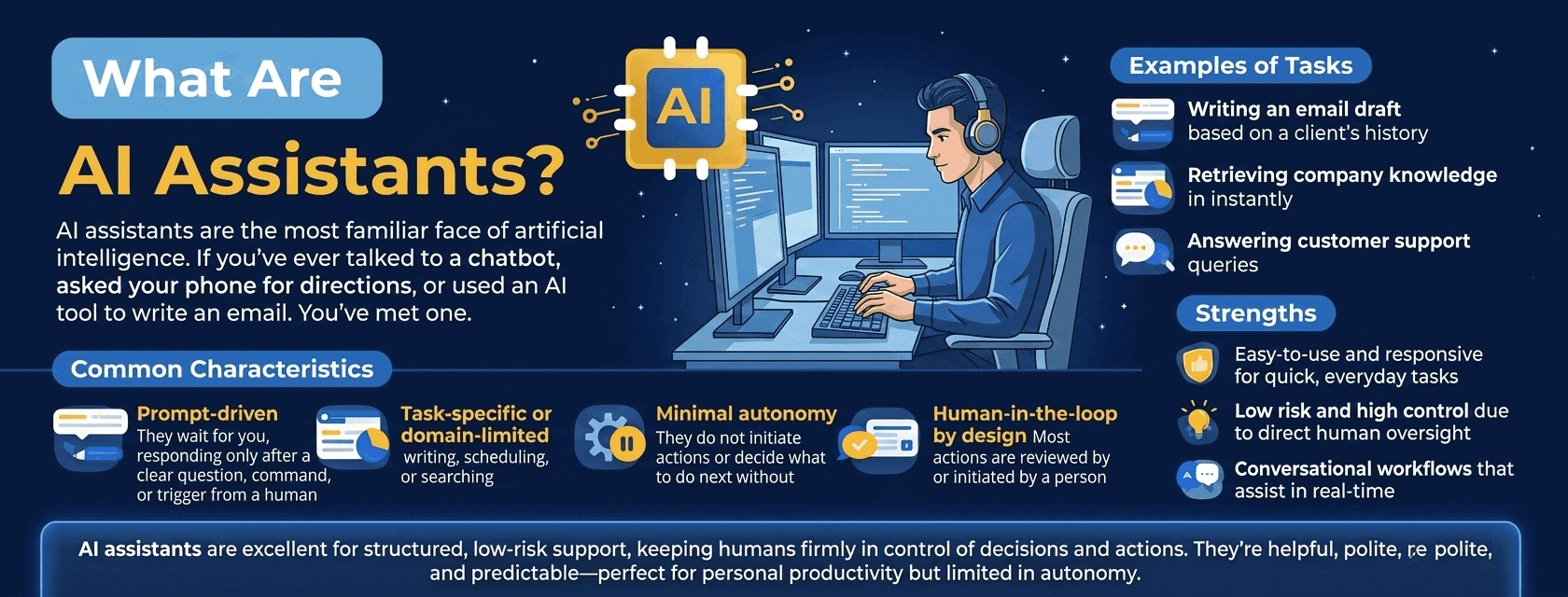
AI assistants are the most familiar face of artificial intelligence. If you’ve ever talked to a chatbot, asked your phone for directions, or used an AI tool to write an email. Congratulations! You’ve met one.
AI assistants are software systems designed to support humans by responding to requests, providing information, or performing limited tasks under direct instruction.
They don’t own goals. They don’t decide priorities. They exist to assist, hence the name.
Here are a few of the common characteristics of AI Assistants:
Prompt-driven (they wait for you, responding only after a clear question, command, or trigger from a human)
Task-specific or domain-limited (they usually operate within a narrow scope such as writing, scheduling, searching, or answering queries)
Minimal autonomy (they do not initiate actions on their own or decide what to do next without guidance)
Human-in-the-loop by design (a person reviews, approves, or initiates most actions to ensure control, accuracy, and accountability)
Predictable and deterministic behavior (they generally follow predefined patterns, rules, or instructions, which makes their outputs easier to anticipate and validate)
Limited ownership of outcomes (they help complete tasks, but responsibility for success or failure ultimately remains with the human user)
Everyday AI assistant examples include,
Writing an email draft when you ask for it, based on a certain client's history
Retrieving company knowledge instantly from internal tools like Slack, Notion, CRM systems, or documentation platforms
Answering customer support questions as per the company policy
Scheduling a meeting after confirmation
Summarizing a document on demand without you having to open/search for it
They’re helpful, polite, and predictable. But they won’t surprise you. Ever.
Loved the concept? Running a business? Don't forget to explore these top enterprise AI assistant examples that can help your business gain 10x more momentum and execute faster.
Strengths of AI Assistants
AI assistants are easy to use and require little to no learning curve, making them accessible even for non-technical users. They are generally low risk because they operate under direct human control, respond only when prompted, and avoid autonomous actions.
Their ability to deliver quick responses makes them especially useful for day-to-day tasks. Overall, they are ideal for personal productivity, helping individuals save time without giving up control or accountability.
Limitations You Should Know
AI assistants lack independent decision-making capabilities and rely entirely on human instructions to move forward. They typically do not retain memory across long or complex workflows unless explicitly engineered to do so, which limits their ability to maintain context over time.
Additionally, they cannot adapt or redefine goals on their own, making them unsuitable for situations that require dynamic prioritization or autonomous course correction.
So, when people ask what are AI assistants? The answer is simple: they’re excellent helpers, but they stop where autonomy begins.
When To Use AI Assistants
You should use AI Assistants when you need structured, low-risk support that keeps humans firmly in control of decisions, approvals, and overall execution. Here are a few places where you could use them:
Tasks are simple or ad-hoc, where a quick response or lightweight support is all that’s required, and there’s no need for deep automation
Human judgment is critical, especially in creative, legal, financial, or sensitive decisions where oversight and discretion matter
You want low risk and high control, keeping final approvals and accountability firmly in human hands
The workflow is conversational, such as drafting content, brainstorming ideas, answering questions, or assisting during live interactions
The task does not require system-to-system coordination or long-running automation across multiple platforms
In modern enterprise environments, AI assistants are evolving beyond simple chat interfaces. AI enterprise assistant platforms such as Action Sync understand internal company data across tools like CRM systems, project management platforms, documentation, and messaging apps. Instead of searching across multiple systems manually, employees can simply ask a question and receive contextual answers drawn from their organization’s knowledge base. This highlights how assistants are increasingly becoming an intelligence layer for everyday work.
What Are AI Agents?
Now we enter a different territory. AI agents aren’t just helpers; they’re doers.
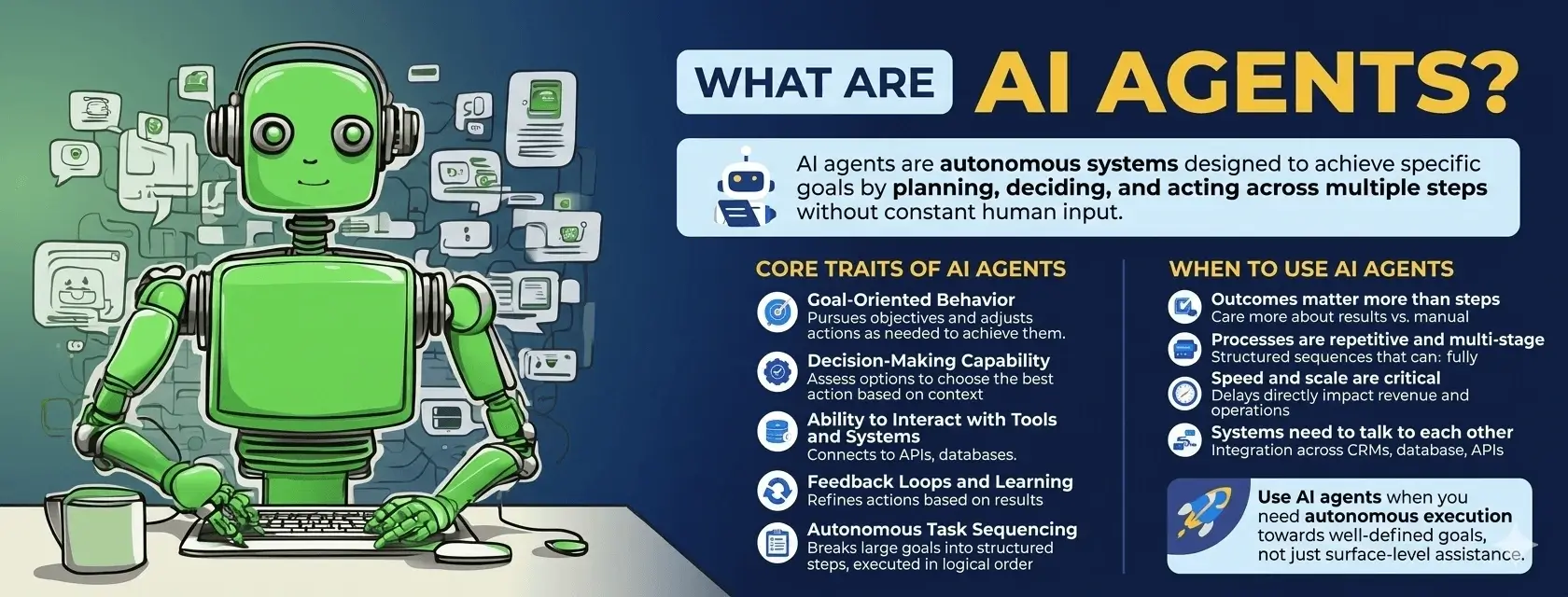
AI agents are autonomous or semi-autonomous systems designed to achieve specific goals by planning, deciding, and acting across multiple steps without constant human input.
If an assistant is like an intern waiting for instructions, an agent is more like a project manager who knows the outcome and figures out the path.
The core traits of AI agents include the following:
Goal-oriented behavior, as they pursue defined objectives and adjust actions as needed to achieve them.
Decision-making capability, as they assess options and choose the best action based on context instead of waiting for step-by-step instructions.
Ability to interact with tools and systems, connecting to APIs, databases, and other agents to complete complex workflows.
Feedback loops and learning, as they analyze results and refine actions for continuous improvement.
Autonomous task sequencing, as they break large goals into structured steps and execute them in logical order.
Context persistence, as they maintain state across sessions to ensure continuity in long-running workflows.
Here are some real-world examples of using AI agents:
Automatically following up with leads until conversion
Monitoring systems and triggering alerts or fixes
Coordinating tasks across tools like CRM, email, and project management
Why AI Agents Feel “Smarter”?
Not because they know more, but because they act more.
They don’t just wait politely for instructions to arrive. Instead, they interpret the objective, map out a strategy, and move forward step by step. This often happens without needing someone to hover over their shoulder. That sense of forward motion is what makes them appear more intelligent in practical settings.
They:
Break down high-level goals into structured sub-tasks, ensuring that complex objectives become manageable and logically sequenced actions
Choose tools dynamically based on context, selecting the right API, database, or workflow component without explicit human direction each time
Adjust actions based on outcomes, analyzing feedback, correcting errors, and refining the path until the defined objective is achieved
Monitor progress continuously, checking whether intermediate milestones are being met and recalibrating if performance drifts
Decide when to escalate to humans, recognizing edge cases or uncertainty, rather than blindly continuing execution
In other words, they don’t just complete tasks; they manage progress. They evaluate, iterate, and optimize as they go. That layered execution model is precisely why they feel more capable in operational environments.
When To Use AI Agents
You should use AI Agents when your priority shifts from assistance to autonomous execution. Especially in situations where outcomes matter more than manual oversight and the system needs to act independently toward clearly defined goals:
Outcomes matter more than steps, meaning you care about the final result and are comfortable delegating how it gets achieved.
Processes are repetitive and multi-stage, involving structured sequences that can be automated end-to-end.
Speed and scale are critical, especially in environments where delays directly impact revenue, operations, or customer experience.
Systems need to talk to each other, requiring integration across CRMs, databases, APIs, and internal tools without manual intervention.
You want continuous monitoring and optimization, with the system evaluating progress and adjusting actions autonomously.
Knowing when to use AI agents vs AI assistants can save months of experimentation, prevent misaligned implementations, and help teams deploy the right level of intelligence from day one.
Interestingly, some emerging enterprise AI platforms combine both models. Tools like Action Sync start as an intelligent enterprise assistant software that understands company knowledge, but they can also trigger automated workflows across business tools when required. This hybrid approach reflects a broader industry shift where AI assistants provide context and insight, while agent-like capabilities execute tasks across systems.
Round-Wise Comparison: Difference Between AI Agents vs AI Assistants [Updated 2026]
Round 1: Purpose and Intent
AI Assistants: Designed to help you. They respond, suggest, remind, clarify, and assist when asked, operating primarily as responsive support systems that rely on human prompts to guide every action they take.
AI Agents: Designed to work for you. They decide, plan, act, and execute tasks independently, often coordinating multiple steps and systems in the background to move an objective forward without requiring constant human direction.
In short, assistants wait for instructions and operate within the boundaries you set. While agents move proactively toward defined outcomes, taking initiative and driving progress on your behalf.
Round 2: Level of Autonomy
AI Assistants: Reactive by design. They wait for prompts, commands, or clearly defined instructions before taking action, and their output is directly shaped by the quality and specificity of the input they receive from a human user.
AI Agents: Proactive by architecture. They can initiate actions based on predefined goals, evaluate changing conditions, and independently determine the next best step without requiring constant prompting or supervision.
One asks, “What would you like to do next?” and patiently waits for direction. The other says, “I’ve already analyzed the objective, taken the necessary steps, and here’s the result,” highlighting the fundamental shift from response-based support to goal-driven execution.
Round 3: Complexity of Tasks
AI Assistants: Handle single-step or simple multi-step tasks, typically focusing on clearly defined actions that can be completed within a limited scope and without requiring dynamic decision-making across multiple systems.
AI Agents: Manage multi-step workflows with dependencies, decisions, and feedback loops, coordinating interconnected tasks that may span tools, timelines, and conditions while continuously adapting to new inputs or results.
Taken together, this difference in task complexity highlights a fundamental divide: assistants operate within clearly defined boundaries, while agents thrive in layered, evolving environments where coordination and adaptation are essential. As tasks become more interconnected and outcome-driven, the gap between simple support and autonomous orchestration becomes impossible to ignore.
Round 4: Trust and Oversight
AI Assistants: Built for transparency and human control. Every action is triggered, reviewed, or refined by a person, which makes them easier to trust in high-stakes, sensitive, or regulated environments.
AI Agents: Operate with greater independence, which can introduce complexity around monitoring, governance, and explainability if guardrails are not properly designed.
When trust, compliance, and step-by-step oversight matter most. AI assistants often win because they keep humans firmly in the driver’s seat rather than shifting control to autonomous systems.
Round 5: Creativity and Collaboration
AI Assistants: Thrive in collaborative, creative workflows. They brainstorm with you, refine your ideas, iterate on drafts, and adapt instantly to feedback in a conversational loop.
AI Agents: Focus on execution efficiency, which makes them powerful for operations but less naturally aligned with open-ended exploration or back-and-forth ideation.
In environments where nuance, tone, and human preference shape the outcome (such as writing, strategy, or design), assistants tend to outperform because they enhance thinking rather than replace it.
Round 6: Risk Management and Control
AI Assistants: Lower operational risk since they require explicit human approval before major actions are taken, reducing the chance of unintended consequences across systems and ensuring that critical decisions are reviewed, validated, and aligned with organizational standards before execution.
AI Agents: Higher leverage but higher responsibility, as autonomous execution can amplify both success and mistakes at scale, especially when operating across multiple systems where a single misstep can cascade quickly without immediate human intervention.
If your priority is stability, gradual adoption, and minimizing downside exposure, AI assistants often come out ahead by balancing capability with control. Thereby, allowing teams to experiment with AI in a measured way while maintaining visibility, accountability, and confidence at every stage of deployment.
Round 7: Scale and Throughput
AI Assistants: Excellent at supporting individual users, but their impact typically scales linearly. You add more users, you get more output. Their strength lies in empowering people one by one, enhancing productivity at the individual level while keeping execution tightly aligned with human intent and oversight.
AI Agents: Built for exponential leverage. A single well-designed agent can handle thousands of workflows simultaneously, operating across systems without fatigue, delays, or bandwidth constraints. Instead of scaling effort person by person, agents scale outcomes directly. Thereby, expanding capacity across departments and processes without requiring proportional increases in manual involvement.
When the goal is enterprise-wide automation and massive throughput rather than individual productivity boosts, AI agents take the lead by multiplying output without multiplying headcount.
Enterprise assistant SaaS such as ActionSync demonstrates this model by enabling teams to access company knowledge instantly while orchestrating automated workflows across tools. Thereby, effectively combining assistant-style insights with agent-level scalability.
Round 8: Operational Efficiency
AI Assistants: Improve efficiency at the task level, helping people complete work faster and with fewer errors while still keeping decision-making grounded in human judgment and contextual awareness. They enhance productivity within clearly defined responsibilities, making everyday execution smoother without fundamentally altering the surrounding workflow.
AI Agents: Redesign efficiency at the system level, eliminating handoffs, reducing bottlenecks, and compressing entire multi-step processes into seamless, automated flows that operate with minimal friction. Instead of optimizing isolated tasks, they reengineer how work moves across teams, tools, and timelines to create end-to-end operational momentum.
If assistants make people faster, agents make processes smarter. In high-volume operational environments where coordination, timing, and scalability determine success, this kind of process-level intelligence becomes a powerful competitive advantage.
Round 9: Outcome Ownership
AI Assistants: Contribute to outcomes, but humans remain fully responsible for stitching together the steps and ensuring completion. They provide insights, draft content, surface recommendations, and assist with execution, yet the ultimate coordination of tasks, prioritization of actions, and verification of final results stay firmly in human hands. In this model, assistants enhance performance without assuming ownership, acting as intelligent collaborators rather than autonomous drivers of delivery.
AI Agents: Own the path to the outcome. They track objectives, adjust strategies, recover from minor failures, and persist until the defined goal is achieved or escalated. Instead of waiting for continuous prompts, agents monitor progress, trigger next steps automatically, and re-route workflows when conditions change. Their value lies not just in action, but in sustained responsibility across the lifecycle of a task.
When accountability shifts from “help me do this” to “make sure this gets done,” AI agents clearly come out ahead by aligning execution directly with measurable results. In environments where outcomes matter more than activity and completion matters more than contribution, that shift from assistance to ownership becomes a decisive advantage.

AI Agents and AI Assistants for Enterprises: What's Better?
Enterprises don’t just need intelligence; they need execution. Strategy without delivery is just theory, and insight without action rarely moves the needle in competitive markets.
Why Enterprises Love AI Assistants?
Safe entry point to AI, allowing teams to experiment without disrupting core systems
Improves employee productivity by accelerating research, drafting, analysis, and decision support
Easy adoption with minimal workflow redesign and low technical barriers
Maintains strong human oversight, which reduces compliance and governance concerns
Delivers quick wins that build internal confidence and stakeholder buy-in
Why Enterprises Move Toward AI Agents?
Automates entire workflows from trigger to completion without constant supervision
Reduces operational overhead by eliminating repetitive coordination and handoffs
Enables 24/7 execution across time zones and business units
Scales processes without proportional increases in headcount
Drives measurable outcomes tied directly to business KPIs
In practice, many enterprises are not choosing between assistants and agents. Instead, they are deploying layered systems where assistants surface knowledge and agents handle execution. For example, enterprise search platforms like Action Sync allow teams to query internal data across multiple tools while also enabling automated workflows when certain conditions are met. This hybrid architecture reflects how modern organizations are blending human guidance with system-level automation.
In large organizations, AI assistants vs. AI agents for enterprises isn’t an either-or choice. It’s a maturity curve that often begins with assistants enhancing individuals and gradually evolves into agents orchestrating systems at scale.
FAQs or Frequently Asked Questions
Q. When should organizations use AI agents and AI assistants?
When to use AI agents vs AI assistants depends on the problem being solved. If the goal is to enhance employee productivity, improve decision quality, or support creative and strategic work, assistants are ideal.
If the goal is to automate repeatable workflows, reduce operational overhead, and scale execution without increasing headcount, agents are more appropriate.
Q. Are AI agents better than AI assistants?
Not universally. In a work setup, assistants often serve as the first step because they are easier to deploy and involve lower risk.
Over time, as processes mature and governance structures strengthen, organizations may transition toward agents for end-to-end automation. The better solution depends on risk tolerance, operational complexity, and desired level of autonomy.
Q. Can AI agents and AI assistants work together?
Yes, and in many modern architectures, they do. Assistants can help humans design strategies, define objectives, and monitor performance, while agents execute defined workflows in the background.
This layered approach allows enterprises to balance control with scalability. Thereby, making the comparison less about competition and more about orchestration.
Q. What are the risks of deploying AI agents compared to AI assistants?
AI agents introduce greater operational risk because they act autonomously. If goals are poorly defined or guardrails are weak, errors can scale quickly.
AI assistants, by contrast, keep humans in the loop at every step, which naturally limits damage. Organizations adopting agents must invest more heavily in monitoring, governance, and fail-safe design.
Q. How does scalability differ in the AI agents vs AI assistants comparison?
In the AI assistant vs AI agent comparison, scalability looks very different.
Assistants scale human capability: one employee can produce more output with the same effort.
Agents scale execution itself: entire workflows can run simultaneously across departments without proportional increases in labor.
The impact is not just productivity, but operational transformation.
Q. Will AI agents replace AI assistants in the future?
It is unlikely that one will completely replace the other. AI assistants serve as cognitive partners that enhance human thinking, while AI agents function as autonomous operators that execute defined goals.
As systems mature, we will likely see hybrid models where assistants guide strategy and agents handle execution, reinforcing the idea that the difference between AI agents and AI assistants is structural, not temporary.

Conclusion
The conversation around agents vs AI assistants is not about declaring a winner. It is about understanding intent, architecture, and responsibility. Throughout this guide, we examined the AI agents vs AI assistants difference across autonomy, risk, creativity, scalability, operational efficiency, and outcome ownership. One pattern stands out clearly: assistants enhance human capability, while agents extend system capability.
So, when to use AI agents vs AI assistants? Use assistants when you want smarter humans. Use agents when you want smarter systems. Use both when you want sustainable transformation.
Ultimately, the difference between AI agents and AI assistants is architectural, not temporary. One supports decisions. The other drives delivery. Organizations that understand this distinction will not be distracted by hype. They will deploy each intentionally, align autonomy with accountability, and build intelligent systems that serve real business goals.
As organizations move toward smarter, AI-powered operations, the real opportunity lies in combining the strengths of assistants and agents rather than choosing between them. Modern enterprise AI assistants like Action Sync are beginning to reflect this shift by helping teams access company knowledge instantly while enabling intelligent workflows across their tools. By bridging insight with execution, systems like these show how AI can move beyond simple assistance toward coordinated action across the organization.
👉 Interested in seeing how this works in practice? Book a FREE demo of Action Sync to explore how enterprise AI can turn raw knowledge into action.